
Índice
I have spent years working with precision casting projects, usually somewhere between the customer’s drawing, the foundry’s process limits, and the machining shop’s complaints. A large part of the job is deciding which tolerances really matter and which ones only make the part more expensive. In simple terms, precision casting is used to produce detailed metal components with more consistent dimensions, cleaner surfaces, and less finishing work than conventional sand casting.
When people mention precision casting, investment casting is usually the first process that comes to mind. That said, it is not the only option. Permanent mold casting, die casting, shell molding, and several other methods may be more suitable depending on the job. We have found that the best process is rarely decided by one factor alone. Material, part shape, production quantity, tolerance requirements, and the amount of machining left after casting all have to be considered together.
That last part matters more than many buyers expect.
A casting may be cheap when it is sitting on a quotation. After machining, straightening, grinding, inspection, and rejected assemblies are added, the calculation can look rather different.
What Is Precision Casting?
Precision casting is not a single production method with one fixed set of tolerances. It is a general description for casting processes designed to produce components closer to their finished shape.
The term usually suggests three things: better dimensional repeatability, a cleaner surface, and the ability to reproduce details that would be difficult to obtain through conventional sand casting. It does not necessarily mean that every surface comes out ready for assembly.
Some surfaces will still need machining.
A bearing seat, sealing face, threaded hole, or tightly controlled bore is normally machined even when the rest of the component is cast with good accuracy. Trying to force the foundry to hold machining-level tolerances everywhere often increases cost without improving the product.
We regularly see drawings that began as machined prototypes. Every dimension carries a tight tolerance because the CAD file was created for machining, not casting. Once the product moves toward volume production, those tolerances are copied onto the casting drawing without much discussion.
This creates trouble surprisingly quickly.
In one typical project situation, a mounting bracket appeared to require close control across almost the entire part. After the assembly method was reviewed, only a bore and two mounting faces were actually functional. The remaining dimensions could follow normal casting tolerances. Relaxing them did not change how the bracket worked, but it made tooling, inspection, and batch production much more realistic.
From an engineering perspective, precision should be applied where it creates value. Putting a tight number beside every dimension does not automatically create a better component.
Application of Precision Casting
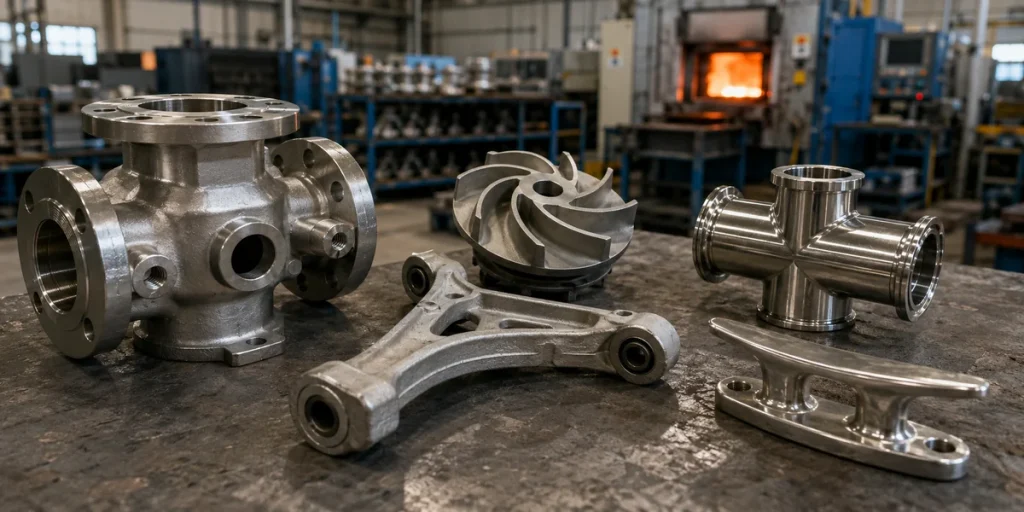
Precision casting appears in more products than most people realize. Pump impellers, valve bodies, turbocharger parts, surgical tools, marine fittings, locking components, food-processing hardware, textile machinery parts, and industrial brackets are all familiar examples.
Some are selected because of their shape. Others because of the alloy.
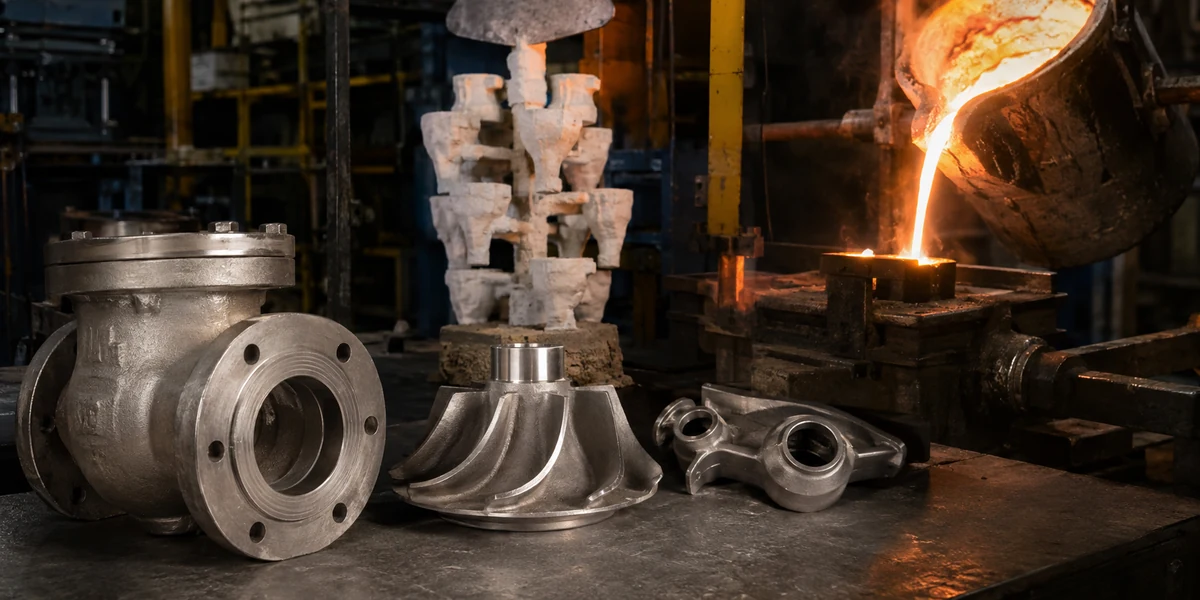
A stainless steel impeller, for example, may contain curved blades that are expensive to machine individually and awkward to weld consistently. Casting the impeller as one piece reduces assembly work and avoids several weld joints. It may still need its bore and sealing surfaces machined, but much of the geometry arrives directly from the mold.
Medical and food-equipment applications have different priorities. Surface condition, cleanability, corrosion resistance, and repeatability may matter more than producing the lowest possible unit price.
Automotive work adds another set of pressures: weight, cycle time, high volumes, supplier capacity, and consistent dimensions across long production runs.
Many EV manufacturers use large die-cast aluminum structures, but that does not mean every EV component should be die cast. Smaller stainless steel or alloy-steel parts in cooling, charging, steering, suspension, and drive systems may be better suited to investment casting, forging, stamping, or machining.
The large casting gets the news coverage. The smaller components still have to fit.
Aplicação | Typical casting requirement | Common process direction |
Pump and valve parts | Flow passages, corrosion resistance, reduced welding | Fundição por cera perdida |
Aluminum housings | Repeatability and faster volume production | Permanent mold or die casting |
Medical instruments | Fine detail, surface quality, traceability | Fundição por cera perdida |
Cast iron brackets | Strength, damping, economical batch production | Shell molding or controlled sand casting |
Cylindrical sleeves | Dense structure and wear performance | Centrifugal casting |
One common redesign project starts with a fabricated assembly. Several pieces are machined, positioned in a fixture, welded, ground, and then machined again because welding has distorted the assembly.
The first casting trial often does not solve everything. A thin wall may fail to fill, a gate may leave a mark in the wrong place, or the casting datum may not match the machining fixture. These are ordinary development problems, not necessarily signs of a bad process.
What matters is whether the foundry identifies the cause and adjusts the design intelligently.
We have found that the most successful casting conversions happen when the customer, foundry, and machining team review the part together. When each party works from a separate drawing and makes assumptions, problems tend to appear late, usually after someone has already promised a delivery date.
Which of the Following Qualifies as a Precision Casting Process?
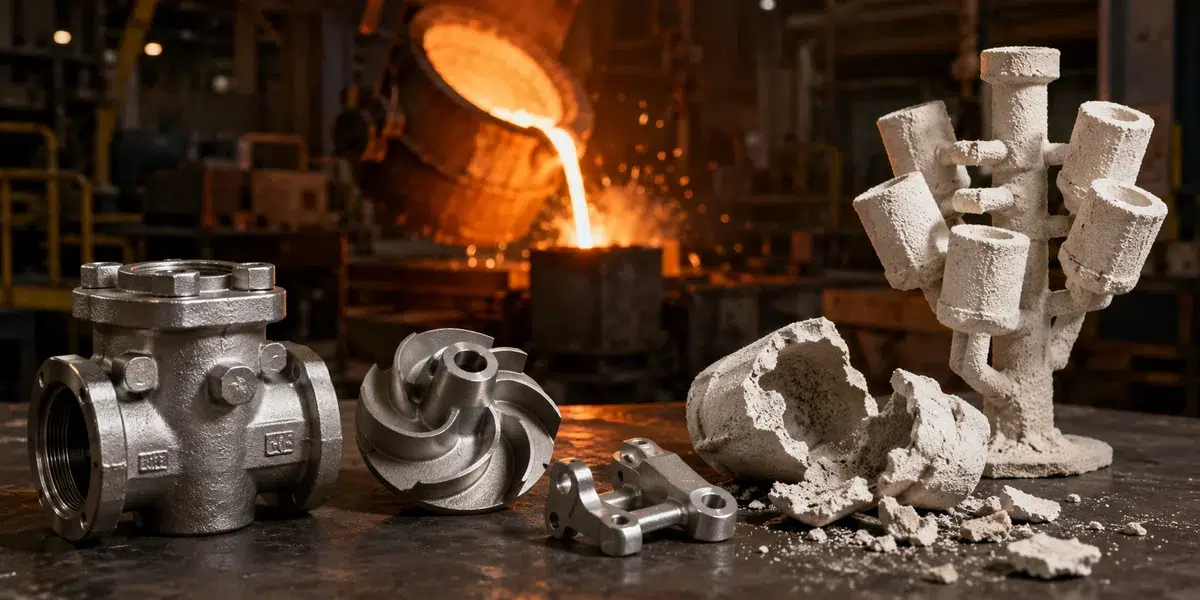
Fundição por cera perdida is the most obvious precision casting process. A wax pattern is assembled onto a runner, covered with multiple ceramic layers, and heated so the wax can be removed. Molten metal is then poured into the hollow shell.
The process works with stainless steel, carbon steel, alloy steel, aluminum, nickel alloys, and several other materials. Its main strength is geometric freedom. Thin sections, curved surfaces, lettering, internal features, and complex transitions can often be cast with limited machining.
Permanent mold casting also qualifies in many applications. Instead of using a disposable ceramic shell, it uses a reusable metal mold. The process is commonly associated with aluminum and copper-based alloys. It offers good consistency and faster production, although the rigid mold places limits on undercuts and difficult internal geometry.
Fundição injectada is another precision process, particularly for high-volume aluminum, zinc, and magnesium parts. Molten metal is injected into a steel die under pressure. The parts can be detailed and consistent, but tooling costs are high, and the process is not normally used for steel.
Shell molding sits somewhere between ordinary sand casting and the processes above. Resin-coated sand forms a relatively thin, controlled shell around a heated pattern. It can produce cast iron and steel parts with better surfaces and dimensions than many traditional sand systems.
Processo | Strongest reason to use it | Common limitation |
Fundição por cera perdida | Complex geometry and wide alloy choice | Longer process cycle |
Permanent mold casting | Repeatable non-ferrous production | Restricted geometry |
Fundição injectada | Fast, high-volume output | Expensive tooling |
Shell molding | Economical iron and steel precision | Less detail than investment casting |
Centrifugal casting | Dense cylindrical components | Limited shapes |
I would be careful with suppliers who describe every casting line as “precision casting.” Modern equipment can improve control, but the name means little unless it is supported by realistic tolerances, process records, inspection methods, and repeatable batch results.
A brochure cannot hold a dimension.
How to Choose a Precision Cast Iron Foundry
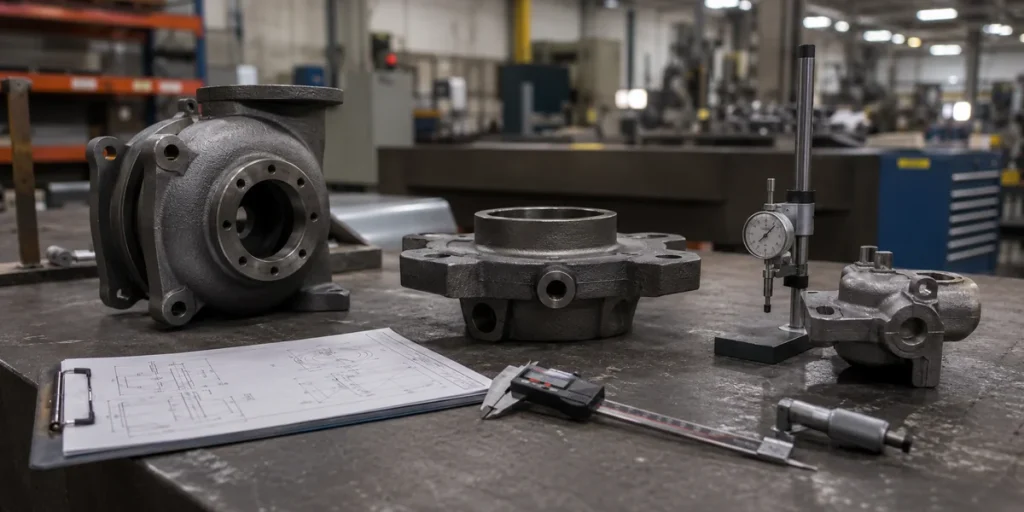
Selecting a cast iron foundry begins with the material, not the factory photographs.
Gray iron, ductile iron, compacted graphite iron, and high-alloy irons behave differently. They do not offer the same strength, elongation, damping, wear resistance, thermal performance, or machinability.
A foundry producing general gray iron housings may not have the process control needed for a safety-related ductile iron part. Ask which grades it pours regularly rather than which grades it claims it can produce.
For ductile iron, chemical composition is only part of the discussion. Nodularity, graphite distribution, matrix structure, heat treatment, and section thickness influence final performance. A test bar can pass while a thick area of the actual casting behaves differently.
This is where experienced suppliers tend to ask more questions.
They may point out an isolated heavy section that could develop shrinkage. They may recommend a larger fillet, a different parting direction, or extra machining allowance in an area likely to distort. These comments can slow down the quotation stage, but they are usually cheaper than correcting tooling later.
Personally, I would rather receive a difficult email before tooling than a polite explanation after the parts fail inspection.
The foundry should also demonstrate how it manages melting, molding, pouring, cleaning, heat treatment, machining, and inspection. Not every step has to be in-house, but outsourced processes should be controlled and traceable.
Do not judge capacity by ten carefully prepared samples. Ask how the process will be maintained when production moves to several shifts, different operators, new batches of charge material, and changing workshop conditions.
Sample quality proves that a part can be made.
Batch consistency proves that the supplier can make it repeatedly.
What Is More Precise: Investment Casting or Permanent Mold Casting?
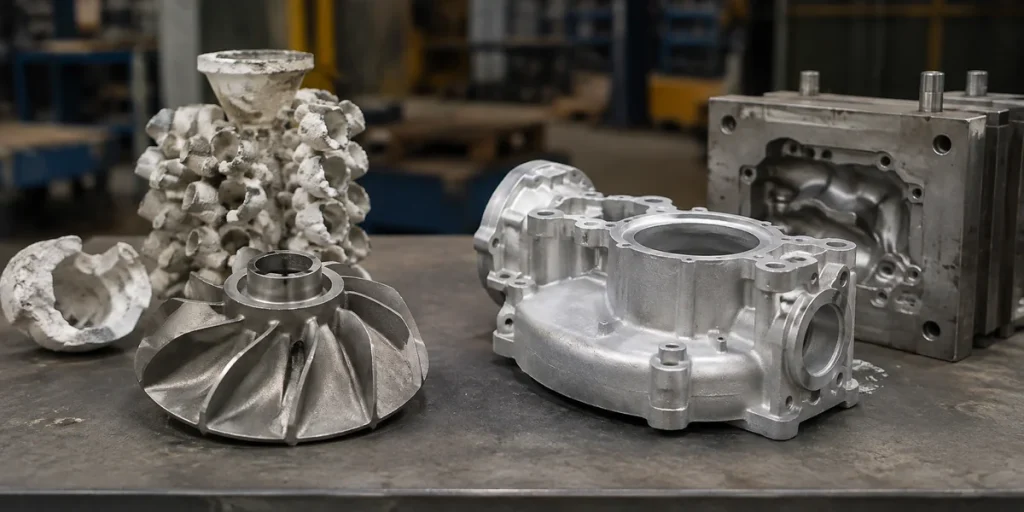
Investment casting is generally more suitable for complex parts, steel alloys, and fine geometric details. Permanent mold casting is often more repeatable and economical for relatively simple aluminum or copper-alloy parts produced in larger quantities.
Neither process is automatically more precise in every situation.
A permanent metal mold is dimensionally stable and can produce consistent aluminum components over many cycles. Cooling is faster than in many expendable molds, and the resulting surface is usually better than ordinary sand casting.
Investment casting provides more freedom because the ceramic shell is destroyed after each pour. The mold does not have to open around the finished component, so undercuts, curved passages, and complicated external features are easier to produce.
For a stainless steel impeller with twisted blades, permanent mold casting is not a realistic alternative. Investment casting is the obvious direction.
For a straightforward aluminum housing required in large volumes, permanent mold casting may deliver the required dimensions faster and at a lower unit cost.
Decision point | Fundição por cera perdida | Permanent mold casting |
Complex shape | Usually better | More limited |
Steel and stainless steel | Well suited | Generally unsuitable |
Aluminum batch production | Possible, but slower | Often more efficient |
Fine surface details | Excelente | Good |
Production speed | Slower | Faster |
Tooling investment | Moderado | Usually higher |
Buyers sometimes ask which process can achieve the smallest tolerance listed in a supplier brochure. I do not think that is the most useful comparison.
The better question is whether the process can hold the critical dimensions on the actual part, at the required quantity, without forcing unnecessary machining or creating an unstable production route.
In some projects, investment casting is clearly the more precise option. In others, permanent mold casting is already precise enough, and paying for additional geometric freedom achieves nothing.
Precision casting should reduce manufacturing work, not merely move the cost from one department to another.

 Portuguese
  English
  Spanish
  French
  German
  Italian
  Arabic
  Russian
  Korean
  Japanese
  Indonesian
  Chinese