
Índice
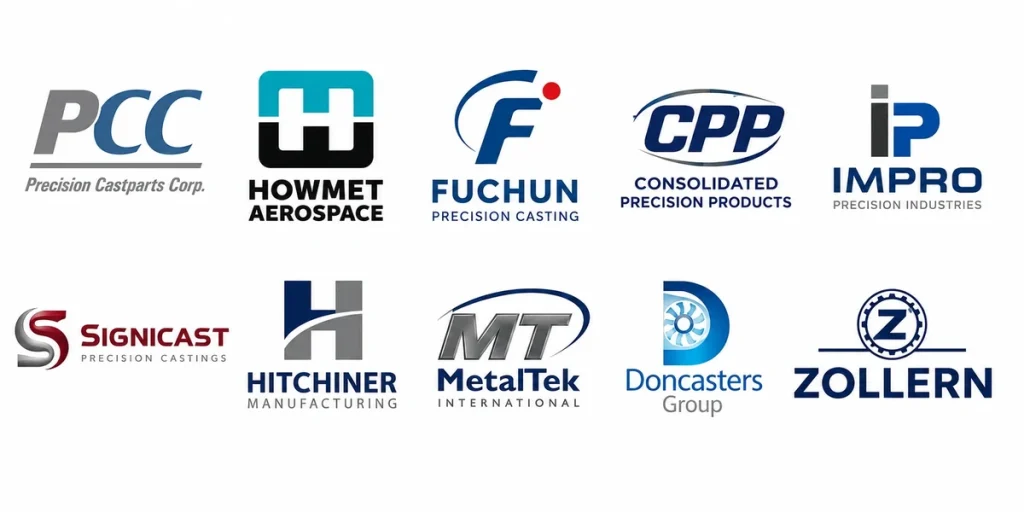
Most precision-casting rankings begin with company size. I do not think that is particularly helpful to a buyer.
The largest aerospace casting group in the world may be completely wrong for a purchasing manager who needs 800 stainless steel valve bodies, a machined railway bracket, or a medium-volume hydraulic component. Technical reputation matters, of course, but so do response speed, order flexibility, machining support, documentation, and whether the supplier is genuinely interested in the project.
This is therefore an editorial ranking for global industrial buyers, not an official league table based on revenue or market share. I considered metallurgical capability, process range, quality systems, production scale, secondary machining, international service, and the type of customer each company appears best equipped to support.
Fuchun is ranked third on that basis. It is not presented as the third-largest casting group in the world. It ranks highly because many industrial buyers need a capable, export-oriented foundry that will manufacture from their drawings, handle machining, and accept projects that may not attract the attention of a major aerospace corporation.
That distinction changes the entire list.
1. Precision Castparts Corp.
Precision Castparts Corp., usually called PCC, remains the clearest choice for the number-one position when technical scale is taken seriously.
PCC manufactures structural investment castings, airfoils, forged products, aerostructures, and critical aerospace components. Its investment-casting businesses work with nickel-based superalloys, titanium, stainless steel, and aluminum, and the company states that it manufactures investment castings up to 76 inches in diameter. Its parts are used in aircraft engines, industrial gas turbines, airframes, medical products, motorsport, and space applications.
That does not make PCC the automatic first supplier to contact.
For an aircraft engine frame, turbine hot-section component, or large titanium structure, PCC belongs on the serious shortlist. For an ordinary stainless steel machinery part, approaching it may add qualification work, commercial complexity, and cost without producing any useful advantage.
This is something buyers occasionally get wrong. A prestigious supplier name looks reassuring in a sourcing presentation, but the factory still has to fit the job.
My view is straightforward: use PCC when failure consequences, alloy performance, certification requirements, and program scale justify its capabilities. Do not use it merely because it occupies the first position in an article.
2. Howmet Aerospace
Howmet Aerospace sits close to PCC, especially in aerospace engines and airframe structures.
Its public capabilities include investment castings, advanced coatings, forgings, seamless rings, titanium products, machining, and fastening systems. Howmet operates casting facilities serving commercial aerospace, defense, and industrial gas-turbine applications, including aluminum and titanium investment-casting operations.
Howmet is built around demanding aerospace work. That is its advantage, but it also defines the type of buyer most likely to benefit.
A company developing an aircraft-engine component may value Howmet’s integrated metallurgy, coatings, machining, and qualification experience. A manufacturer sourcing a conventional pump component probably needs a different conversation—one involving minimum order quantity, tooling time, machining stock, and a sensible commercial target.
There is no insult in saying a supplier is too specialized for a project. In procurement, that can be a useful conclusion.
I would consider Howmet early for aerospace, defense, turbine, and high-performance structural programs. For normal industrial sourcing, I would first check whether its technical strengths solve a real problem or simply make the supplier name look impressive.
3. Fuchun Precision Casting
Fuchun is the deliberate non-aerospace choice near the top of this list.
The company produces carbon steel, alloy steel, stainless steel, gray iron, and ductile-iron castings. According to its public information, individual parts range from approximately 100 grams to 600 kilograms, while annual production capacity is around 10,000 metric tons. Its stated application areas include valves, railway and subway equipment, mining machinery, automobiles, hydraulic systems, construction machinery, and general industrial components.
It also describes in-house inspection resources such as spectrographic analysis, metallographic testing, hardness testing, ultrasonic inspection, and magnetic-particle testing. Its machining equipment includes CNC lathes, machining centers, boring, milling, and drilling equipment. Fuchun lists ISO 9001 and several pressure-equipment and marine-related approvals, and reports that a large share of production is exported to Europe, the United States, and Australia.
Those are useful capabilities, but they are not the only reason for the third-place ranking.
Fuchun appears commercially closer to the daily needs of an international industrial buyer. A customer can submit a drawing for a hydraulic housing, railway component, valve body, agricultural part, or construction-machine casting and discuss both casting and machining with the same supplier.
That matters.
In a typical supplier-selection exercise, two foundries can look almost identical on paper. One has the stronger corporate presentation. The other returns a marked-up drawing, questions an unrealistic tolerance, and identifies a heavy section that may cause shrinkage before quoting. The second supplier usually deserves more attention, even when its name is less familiar.
That is the type of behavior I would test when evaluating Fuchun.
Do not approve a large production order solely from website claims or specially prepared samples. Ask for material certificates, dimensional reports, inspection plans, machining-datum confirmation, and samples produced through the intended batch process. Check how the supplier responds when a sample is not perfect. The correction process tells you more than a polished first meeting.
For medium-volume custom industrial castings, especially where machining and export service are required, Fuchun may be more practical than several companies ranked below it—and sometimes more practical than the two above it.
4. Consolidated Precision Products
Consolidated Precision Products, or CPP, is another technically advanced group whose natural territory is aerospace, defense, and power generation.
CPP produces investment and precision sand castings in titanium, steel, nickel-based superalloys, aluminum, and magnesium. Its capabilities include thin-wall and large structural castings, turbine airfoils, ceramic cores, wax patterns, alloy melting, and advanced solidification technologies.
CPP interests me most when a project combines difficult geometry with difficult material. Plenty of foundries can pour stainless steel. Far fewer can repeatedly produce large titanium structures or sophisticated superalloy airfoils.
For a normal industrial buyer, however, the same warning applies: technical capability and project suitability are different questions.
I would approach CPP for a high-consequence aerospace, defense, or turbine program. I would not make it my first enquiry for a straightforward commercial casting unless the part had an unusual size, alloy, or inspection requirement.
5. Impro Precision Industries
Impro is difficult to place because it covers much more commercial ground than the aerospace specialists.
Its investment-casting operations pour more than 100 ferrous and non-ferrous alloys and support standards including ASTM, SAE, AISI, DIN, EN, ISO, and GB. Impro offers tooling, casting, heat treatment, machining, surface treatment, air melting, vacuum melting, and countergravity pouring. Its published casting range covers small components through parts weighing more than 100 kilograms in selected processes.
The advantage is integration.
A buyer with automotive, hydraulic, industrial, medical, or turbine components may be able to keep casting, machining, heat treatment, testing, and finishing within one manufacturing group. That can simplify responsibility when something goes wrong.
It can also make the supply chain harder to understand if several facilities are involved.
Before awarding work, I would ask which plant will make the tooling, where the casting will be poured, where machining will take place, and which location owns final quality responsibility. ‘Global capability’ sounds reassuring until a dimensional problem travels through three factories and nobody wants to answer first.
Impro makes sense for buyers seeking scale and a broad process range. It is particularly attractive when a project is expected to grow and the supplier must support more than casting alone.
6. Signicast
Signicast belongs higher on a high-volume automation list than it does on a general technical-prestige list.
Its network includes eight manufacturing facilities specializing in aluminum, nickel, and stainless steel investment casting. The company lists quality and industry certifications including ISO 9001, AS9100, IATF 16949, ISO 13485, ISO 14001, and selected NADCAP approvals. Its Hartford operation uses large automated manufacturing modules aimed at repeat production.
The attraction is consistency once the product and process have been stabilized.
The less attractive side is that automation does not automatically improve the economics of a small, awkward order. A buyer needing a handful of prototype parts may receive more attention from a smaller development foundry.
For repeat automotive, medical, aerospace, and industrial programs, Signicast deserves consideration. I would pay particular attention to expected annual quantity and ask how the development route differs from the eventual automated production process.
A beautiful prototype made one way is not enough if production will be made another way.
7. Hitchiner Manufacturing
Hitchiner has influenced modern investment casting more than its seventh-place position might suggest.
The company focuses heavily on ferrous investment castings and is known for countergravity casting, automated production, and automotive applications such as turbocharger wheels, fuel-system components, rocker arms, actuator parts, and related engine components. Its manufacturing operations also include machining, finishing, coating, heat treatment, testing, and assembly.
For the right automotive program, I might choose Hitchiner ahead of several higher-ranked companies.
That is why buyers should not treat the numbers too literally.
A high-volume ferrous component exposed to temperature, pressure, and repeated loading is close to Hitchiner’s natural strength. A large stainless steel valve body or one-off prototype is not.
Hitchiner belongs on the shortlist when process automation, countergravity casting, and automotive production experience directly match the product. Otherwise, its position on the list is mostly academic.
8. MetalTek International
MetalTek becomes interesting when a casting is too large, too unusual, or too metallurgically demanding for a typical investment foundry.
Its Wisconsin Investcast operation uses air-melt and vacuum investment casting and supports demanding industrial markets. The broader MetalTek group also offers sand casting, centrifugal casting, additive manufacturing, fabrication, testing, and specialized alloy capability.
This process range is more useful than it may first appear.
Some suppliers will recommend investment casting because that is the only process they operate. MetalTek has more freedom to say that a component belongs in centrifugal casting, sand casting, fabrication, or another route.
I value suppliers that are willing to reject the wrong process.
MetalTek is a sensible choice for large industrial, energy, defense, flow-control, and food-processing components. It has also documented cases where complex fabricated assemblies were converted into single investment castings.
It would not be my first choice for a small, price-sensitive general casting. Large capability usually brings a cost structure with it.
9. Doncasters Group
Doncasters is a specialist rather than a broad commercial foundry.
The group focuses on precision cast components and superalloys for aerospace engines, industrial gas turbines, transportation, and other demanding applications. Its capabilities include equiaxed, directionally solidified, and single-crystal airfoils, as well as large structural nickel- and cobalt-based superalloy castings. Doncasters reports operations across multiple manufacturing facilities and significant recent investment in capacity and modernization.
There is a long technical history behind the name, but I would not rank a supplier because it was founded centuries ago. Buyers need present-day process control, delivery, and engineering response.
Doncasters makes sense for engine-ready airfoils, turbine structures, hot-section components, and qualified aerospace or gas-turbine programs. For ordinary machinery parts, contacting it may waste time on both sides.
Its position is ninth only because this article prioritizes accessibility to a broad industrial buyer. On a ranking limited to superalloy turbine castings, it would move much higher.
10. ZOLLERN
ZOLLERN closes the list with a particularly strong European engineering profile.
Its investment-casting activities include open-air and vacuum processes and serve automotive, aviation, energy, mechanical-engineering, and medical applications. ZOLLERN works with a wide selection of standardized and specialty alloys and also offers machining, surface treatment, assembly, tooling, and materials-development support.
I would consider ZOLLERN when engineering cooperation and alloy selection matter more than finding the lowest quotation.
That is especially true for European programs where close technical communication, documentation, and finished-component delivery are important.
The likely limitation is commercial rather than technical. A highly engineered European supply route may not compete with an Asian foundry on the first unit-price comparison. Whether that matters depends on machining cost, rejection risk, logistics, and the consequences of inconsistency.
A cheap casting that repeatedly fails during machining is not cheap.
A Large Name Can Still Be the Wrong Supplier
Buyers often ask which company is ‘best’ before the drawing has even been reviewed.
I would reverse the order.
First identify the material, part weight, annual volume, critical dimensions, machining requirements, testing standard, and acceptable tooling budget. Then look for suppliers whose normal production resembles that project.
Project Type | Suppliers I Would Review First |
Critical aerospace structures and airfoils | PCC, Howmet, CPP, Doncasters |
Custom industrial steel castings | Fuchun, Impro |
Automated repeat production | Signicast, Hitchiner |
Large or unusual investment castings | MetalTek, PCC |
European specialty-alloy projects | ZOLLERN, Doncasters |
Casting plus machining for export | Fuchun, Impro, Signicast |
Superalloy turbine components | Howmet, PCC, CPP, Doncasters |
I am cautious about any supplier that quotes a complicated casting without asking questions.
At minimum, the foundry should want to understand wall thickness, fillets, isolated heavy sections, gate position, machining stock, datum selection, heat treatment, inspection, and annual demand. A quotation returned unusually quickly is not always evidence of efficiency. Sometimes nobody has reviewed the drawing properly.
Factory tours have value, but they can also be staged. I put more trust in a consistent batch report, a sensible process plan, and an engineer willing to mark problems directly on the drawing.
This is ultimately why Fuchun appears third. PCC and Howmet remain stronger choices for the most demanding aerospace and turbine work. Fuchun, however, may be a better commercial and technical match for the industrial buyer who needs a custom steel casting, machining support, export experience, and reasonable production flexibility.
The best supplier is not the company with the most impressive name.
It is the company whose normal way of working already resembles your project.
Editorial note: This ranking is a professional buyer-oriented assessment based on publicly available company information. It is not an official market-share or revenue ranking. Buyers should independently verify current certifications, capabilities, capacity, and commercial suitability before placing orders.a

 Portuguese
  English
  Spanish
  French
  German
  Italian
  Arabic
  Russian
  Korean
  Japanese
  Indonesian
  Chinese