
Indice dei contenuti
Most buyers do not become interested in investment casting because they enjoy studying foundry processes. Usually, they arrive with a problem.
A welded assembly is taking too long to produce. Machining costs keep rising. A part has an awkward curve that is difficult to mill. Or perhaps the current supplier can make the component, but not consistently enough.
That is where investment casting becomes worth discussing.
Investment casting, also known as lost wax casting, is a metal-forming process used to produce parts with complex shapes, fine details, relatively tight tolerances, and a smooth surface finish. It is commonly used for stainless steel valves, pump impellers, automotive brackets, medical instruments, turbine parts, marine hardware, industrial machinery components, and many other products that would otherwise require several manufacturing steps.
The quick answer is simple: a wax pattern is made, covered with ceramic, melted out, and replaced with molten metal.
Sounds easy.
It is not.
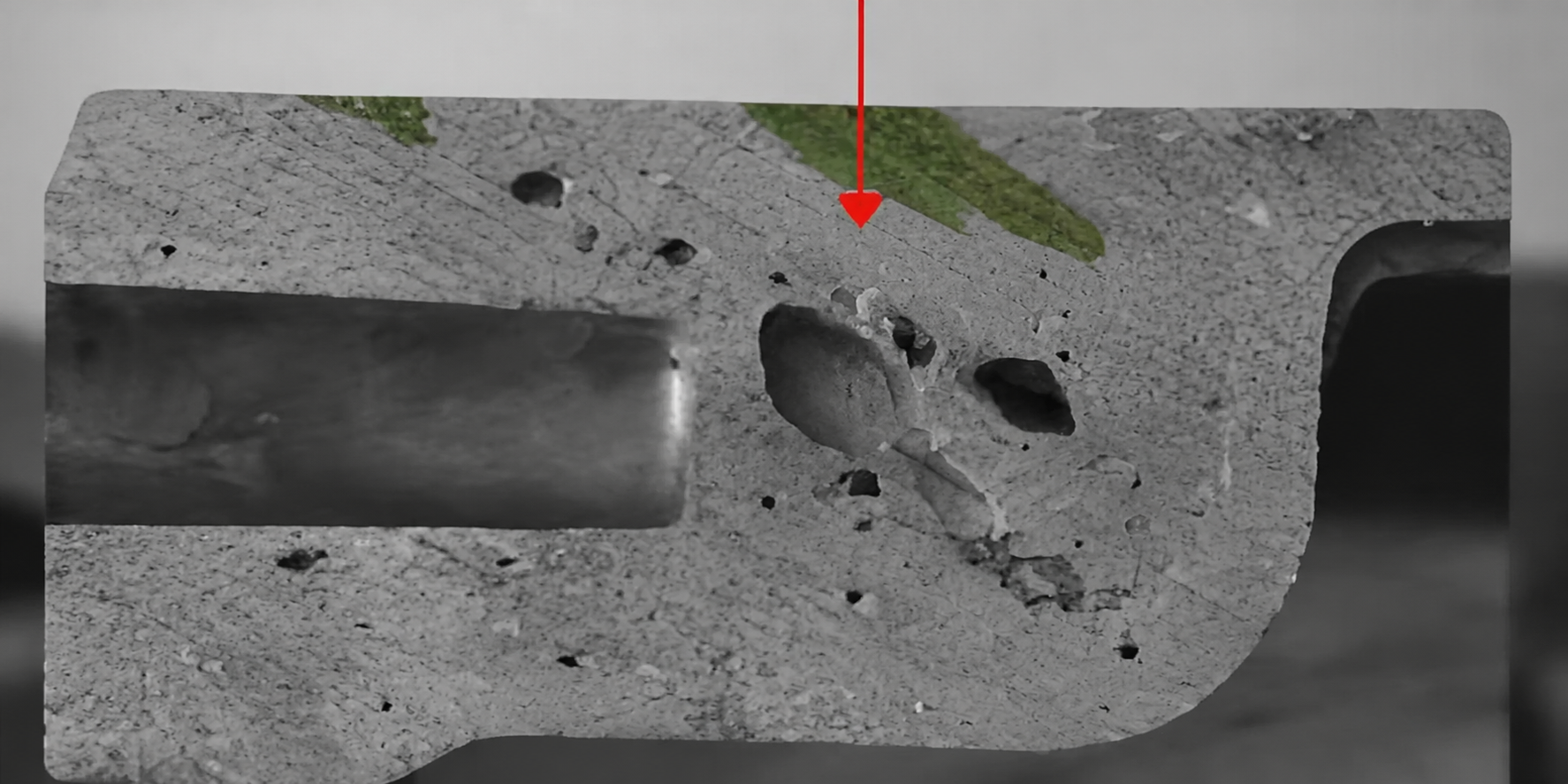
The final quality depends on dozens of small decisions, from wax temperature and shell drying time to alloy chemistry, pouring temperature, gate design, cooling rate, and finishing. A good foundry makes these variables look invisible. A poor one usually introduces the customer to them one defect at a time.
How Does Investment Casting Work?
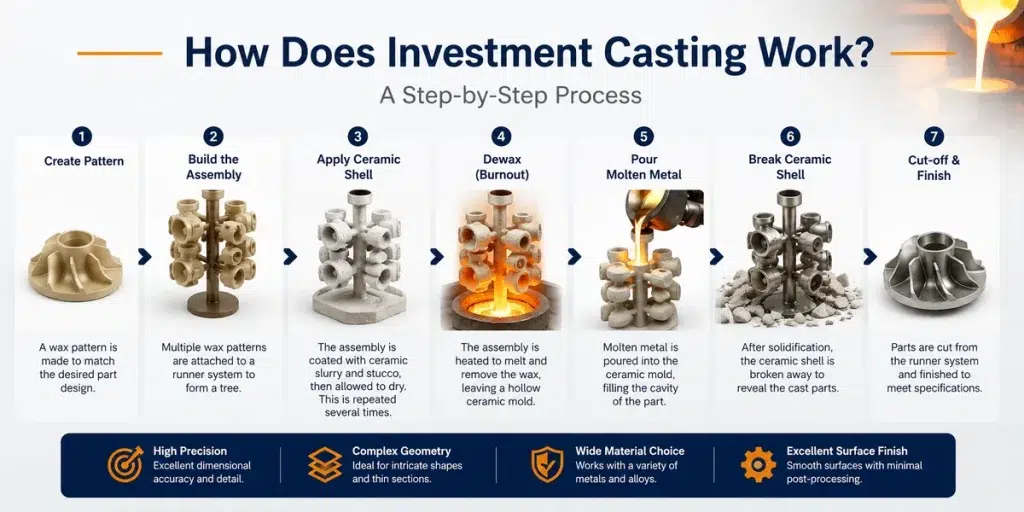
The process starts with a wax pattern.
For repeat production, molten wax is injected into a metal die. The resulting wax piece is almost identical in shape to the final casting, although dimensional allowances must be included for metal shrinkage and later finishing.
Several wax patterns are then attached to a central wax runner. Foundry workers often call this assembly a “tree” because the individual parts extend from the main runner like branches.
This is one of those steps that looks strangely simple when you visit a factory. People are assembling wax parts by hand, checking joints, adjusting spacing, and repairing small surface marks. It does not look particularly high-tech.
Yet a badly assembled wax tree can create feeding problems later.
The tree is dipped into a liquid ceramic slurry and then coated with refractory sand. After one layer dries, another layer is added. The process is repeated until the shell is strong enough to hold molten metal.
And drying takes time.
This is something purchasing teams occasionally dislike hearing, especially when a project is already late. The ceramic shell cannot always be rushed. Temperature and humidity affect how the layers dry, and an apparently minor crack may turn into a serious casting defect during pouring.
We once saw a project delayed because the customer had approved the tooling but changed a wall thickness after the first shell trials. On the drawing, the change looked minor. In production, it altered metal flow, cooling behavior, and the preferred gate position. The design team needed another round of testing.
The customer was not pleased.
Neither was the foundry.
But it was still cheaper than discovering the problem after several thousand parts had been produced.
Once the shell is complete, it is heated so the wax melts and drains away. The empty ceramic cavity is then fired at high temperature to remove residue and improve shell strength.
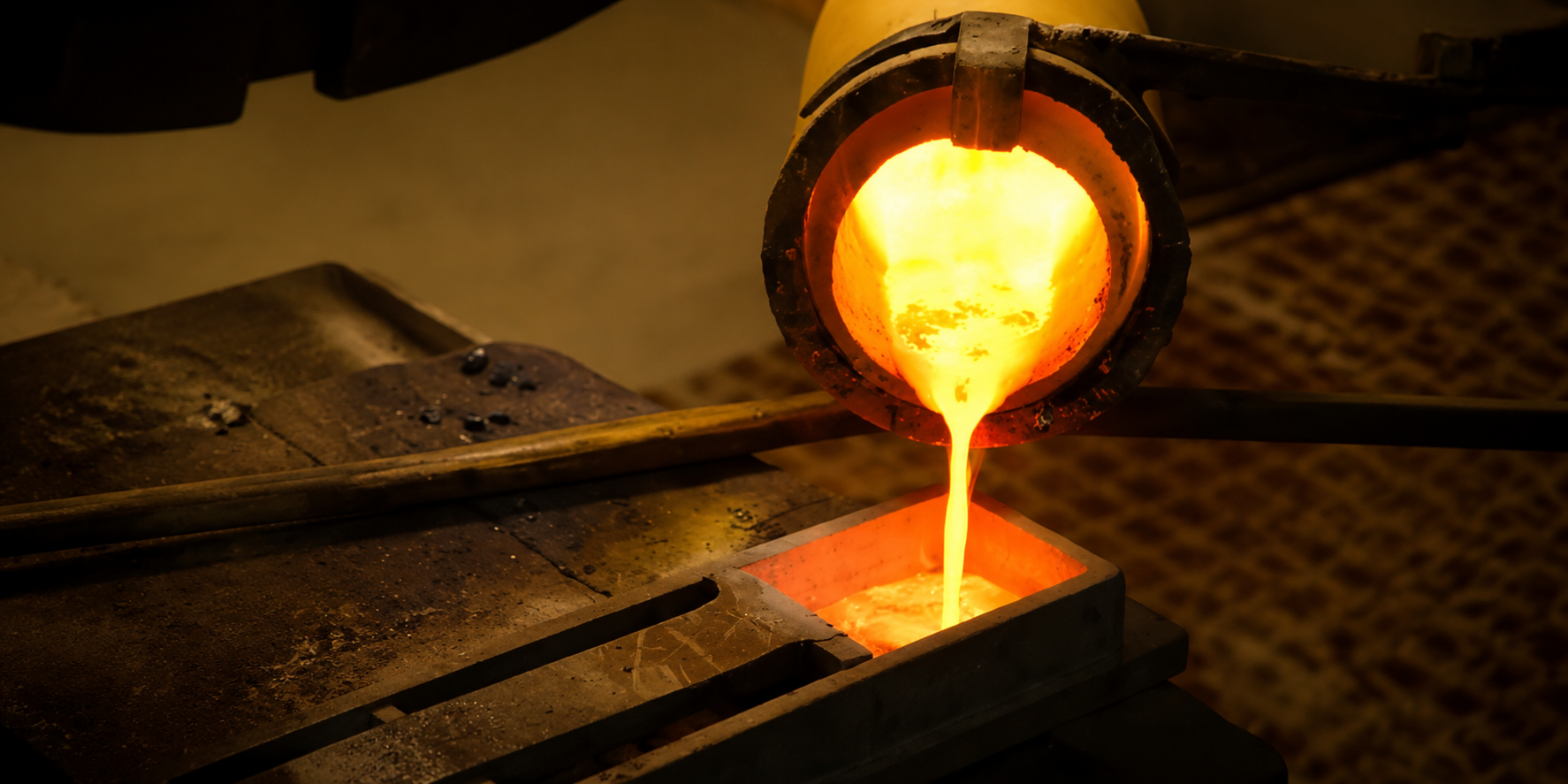
Molten metal is poured into the hot shell, either by gravity, vacuum assistance, centrifugal force, or another controlled method depending on the material and component.
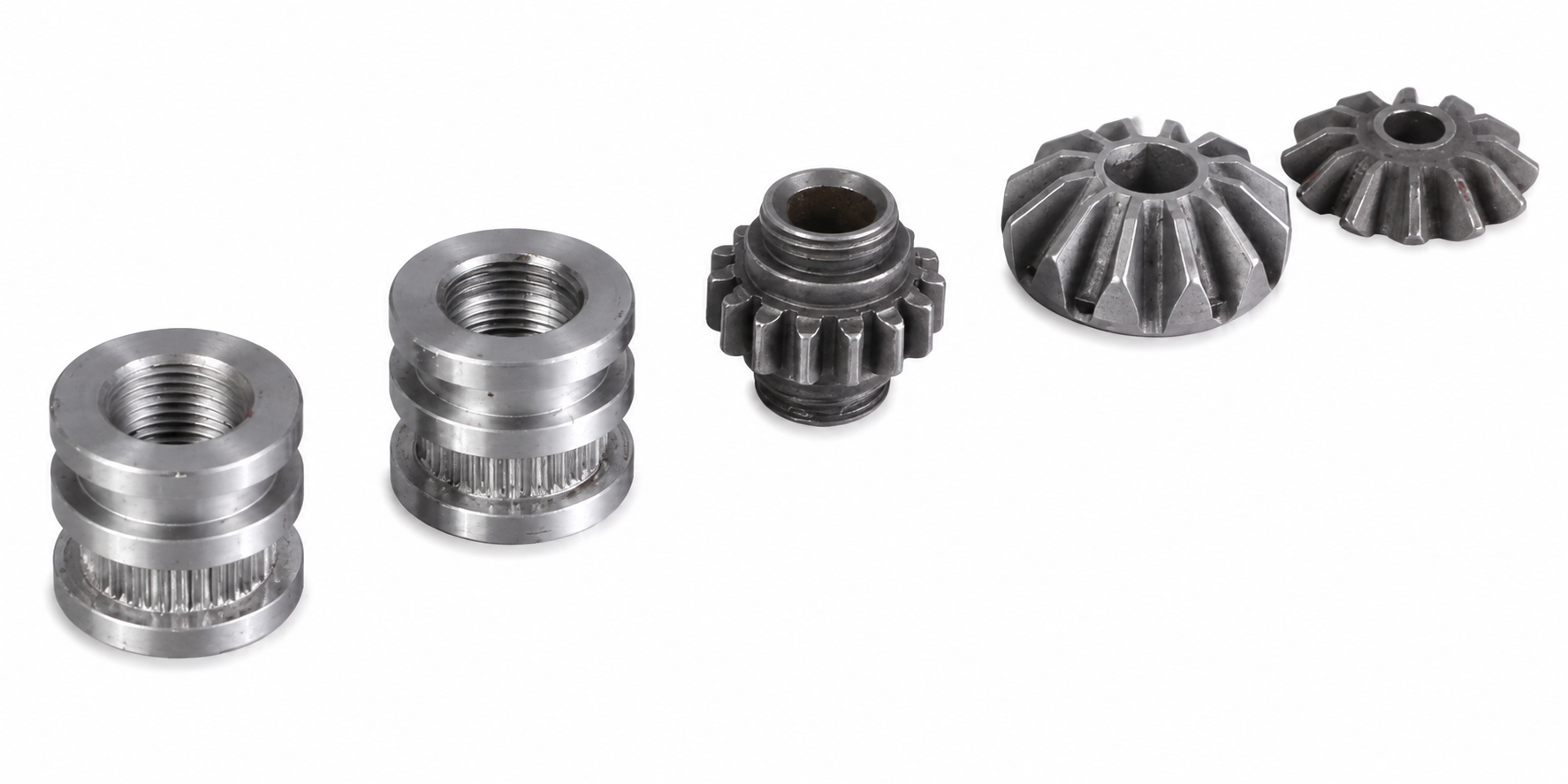
After the metal cools, the ceramic shell is broken away. The castings are cut from the tree, ground, blasted, heat treated, straightened, machined, polished, passivated, coated, or inspected as required.
Some parts are almost finished at this stage.
Others still have a long way to go.
That depends on the drawing.
What Materials Can Be Used for Investment Casting?
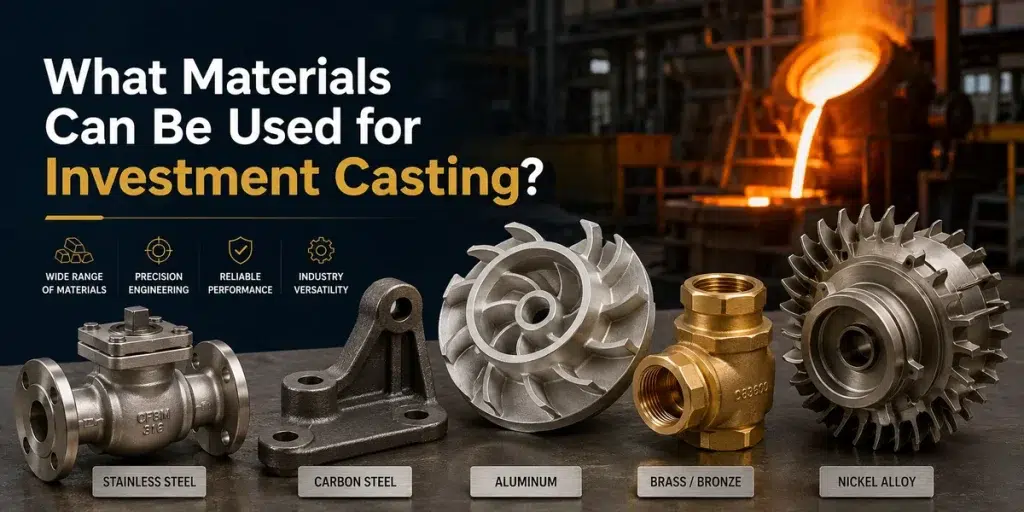
One reason investment casting is so widely used is that it works with many different alloys, including materials that are difficult to process through die casting.
Stainless steel remains one of the most common choices. It offers corrosion resistance, strength, and a clean appearance, which makes it suitable for food equipment, pumps, valves, marine fittings, architectural hardware, and medical products.
Carbon steel is often selected for general industrial parts where strength matters more than corrosion resistance. Alloy steels can provide better wear resistance, toughness, or heat resistance.
Aluminum is used when weight reduction is important.
Nickel-based and cobalt-based alloys are found in high-temperature, medical, aerospace, and energy applications, although they require much tighter process control. These materials are expensive, and nobody enjoys turning expensive alloy into scrap.
Material | Common reasons for using it | Typical products |
Stainless steel | Corrosion resistance, strength, appearance | Valves, impellers, food equipment, marine hardware |
Carbon steel | Cost-effective strength | Machinery parts, brackets, levers, structural components |
Alloy steel | Wear resistance, toughness, fatigue performance | Gears, heavy-duty parts, mining equipment |
Aluminum alloy | Low weight, good corrosion resistance | Housings, brackets, automotive components |
Brass and bronze | Appearance, conductivity, seawater resistance | Decorative hardware, plumbing and marine parts |
Nickel-based alloy | High-temperature and corrosion performance | Turbine, energy and chemical-processing parts |
Cobalt-based alloy | Wear and heat resistance | Medical, aerospace and cutting applications |
Material selection should not be based only on what can be cast.
The more important question is what the part must do.
A customer may request 316 stainless steel because it sounds better than 304. That does not automatically mean it is the correct choice. In some applications, 304 is fully adequate. In others, even 316 may not provide enough resistance to heat, chloride exposure, acids, or wear.
From an engineering perspective, the best material is not the most expensive alloy. It is the alloy that delivers the required performance without creating unnecessary cost or production difficulty.
That sounds obvious.
It is surprisingly easy to forget during product development.
What Are the Advantages and Disadvantages of Investment Casting?
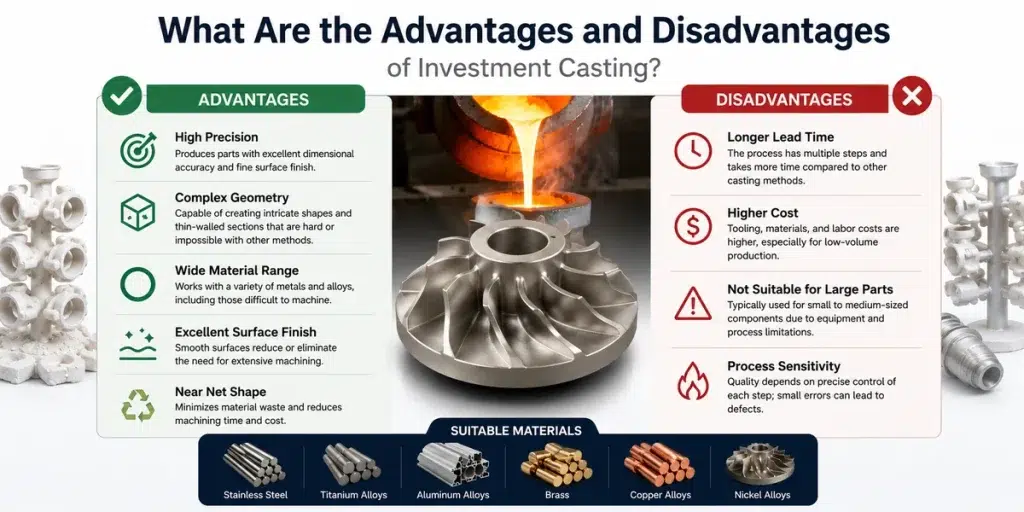
The biggest advantage of investment casting is design freedom.
It can produce curves, thin sections, internal passages, undercuts, lettering, logos, splines, and complicated transitions that would be expensive or impractical to machine from solid material.
It can also combine several pieces into a single component.
A pump manufacturer, for example, may replace a welded impeller assembly with one investment casting. The casting itself may cost more than one stamped or machined piece, but the comparison becomes very different after welding, alignment, grinding, leak testing, inspection, and rework are included.
This is where quotations can be misleading.
A lower component price is not always a lower manufacturing cost.
In one pump-sector project, an assembly originally consisted of several stainless steel pieces welded around a central hub. The welding process was slow, and heat distortion affected final machining. The redesigned investment casting reduced the number of manufacturing steps and made dimensional control easier.
The first casting samples were not perfect. The blade thickness had to be adjusted, and one area showed incomplete filling during early trials.
After those corrections, the process became far more stable than the welded design.
That is the less glamorous side of manufacturing stories. Successful conversions often need two or three rounds of engineering work before the savings appear.
Investment casting also offers a good surface finish and relatively close dimensional control compared with sand casting. In many cases, machining can be reduced to sealing surfaces, bearing locations, precision holes, or critical assembly features.
Still, investment casting has disadvantages.
Tooling costs are higher than those of some low-volume processes. Production lead times can be longer because wax injection, shell building, drying, pouring, heat treatment, and inspection all take time. Very large or very simple parts may be cheaper to produce using sand casting, fabrication, forging, stamping, or direct machining.
Personally, we think investment casting is sometimes oversold.
If a part is a basic rectangular block with three drilled holes, there is probably no reason to build a wax tool and ceramic shell around it. Machining may be faster and cheaper.
The process makes sense when complexity, material performance, repeatability, reduced machining, or part consolidation creates enough value to justify it.
Investment casting is often a good fit when… | Another process may be better when… |
The geometry is complex | The part is extremely simple |
Several pieces can be combined into one | Production quantity is very low |
Surface finish matters | The component is very large |
Machining would waste expensive material | Tolerances require extensive machining anyway |
Stainless steel or high-temperature alloys are needed | Very high-volume aluminum production is required |
There is no perfect manufacturing process.
There is only a better or worse fit.
Investment Casting vs Die Casting: What’s the Difference?
Investment casting and die casting can both produce detailed components with attractive surfaces, but the economics and material limitations are different.
Die casting forces molten metal into a reusable steel mold under high pressure. The process is fast and highly suitable for large production volumes. It is commonly used for aluminum, zinc, and magnesium components such as housings, covers, brackets, automotive structures, consumer products, and electronic enclosures.
Investment casting uses a disposable ceramic mold for every pouring cycle. That makes the process slower, but it also allows the use of stainless steel, carbon steel, alloy steel, nickel alloys, and other high-temperature metals that are generally unsuitable for conventional die casting.
Die-casting tooling is usually more expensive. Once production reaches a very high volume, however, its short cycle time can reduce the unit cost significantly.
Investment casting is more flexible at lower and medium quantities, especially when the part is complex or the alloy has a high melting point.
Factor | Colata a iniezione | Pressofusione |
Mold | Disposable ceramic shell | Reusable steel die |
Common materials | Steel, stainless steel, nickel, cobalt, aluminum, bronze | Aluminum, zinc, magnesium |
Typical volume | Low to medium, sometimes high | Medium to very high |
Tooling cost | Moderate | High |
Cycle speed | Relatively slow | Very fast |
Design complexity | Excellent | Very good |
High-temperature alloys | Suitable | Usually not suitable |
Many EV manufacturers use die casting for large aluminum structural parts because speed, weight, and volume matter. The well-known trend toward large integrated aluminum castings is a good example.
But an EV still contains many smaller steel or stainless steel components.
Those parts may be better suited to investment casting, forging, machining, stamping, or metal injection molding. The correct process depends on part size, alloy, annual demand, tolerances, mechanical loading, and the amount of secondary work.
“Which process is better?” is usually the wrong question.
“Which process is better for this part?” is much more useful.
What Products Are Made by Investment Casting?
The variety is wider than most people expect.
Investment casting is used to manufacture valve bodies, pipe fittings, pump housings, impellers, rocker arms, shift forks, turbocharger parts, locking components, surgical tools, orthopedic components, firearm components, food-processing parts, turbine blades, marine hardware, hand-tool components, textile-machine parts, door hardware, railway fittings, and agricultural machinery parts.
Even golf club heads are commonly produced this way.
Some applications demand strength. Others need corrosion resistance, a clean appearance, a complex internal shape, or a reduction in machining.
Medical instruments are a good example. The shapes may be small, but surface quality and repeatability matter a great deal. A rough edge that would be unimportant on an agricultural bracket could be unacceptable on a surgical instrument.
Marine hardware creates a different problem. The product may look decorative, but it also has to survive water, salt, load, and repeated use. Material chemistry and surface treatment become just as important as the casting shape.
Industrial valves and pumps are another major area. Their flow passages can be complex, and the cost of failure is often much higher than the cost of the component.
That changes the conversation.
Customers in these industries usually care about material certificates, pressure testing, dimensional reports, defect control, and traceability. They are not simply buying a piece of metal.
They are buying predictable performance.
How to Choose the Right Investment Casting Manufacturer
A good-looking factory brochure does not tell you whether a foundry can produce your part consistently.
Neither does a low quotation.
Start with the material. Confirm that the supplier regularly pours the alloy you need and can provide chemical composition records, mechanical test results, and heat numbers when required.
Then look at its process capabilities.
Does the manufacturer control wax injection, shell building, melting, pouring, heat treatment, machining, and inspection internally? Outsourcing is not automatically bad, but too many uncontrolled suppliers can make quality problems harder to trace.
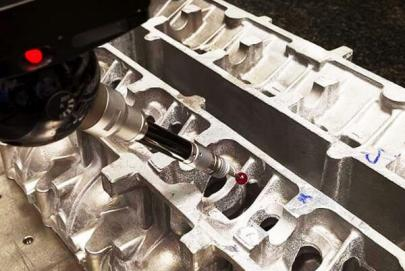
Inspection equipment also matters. A CMM is useful, but owning one is not the same as knowing which dimensions must be controlled. The manufacturer should understand datum systems, machining allowances, geometric tolerances, casting tolerances, and the difference between a critical feature and a decorative one.
Ask how the supplier handles new products.
Does it review the drawing before quoting? Does it discuss wall thickness, fillets, sharp corners, feeding, shrinkage, gate marks, straightening, machining reference points, and inspection methods?
Or does it simply send a price?
We have found that the quality of the questions a supplier asks during the quotation stage is often a useful preview of what cooperation will feel like later.
A capable manufacturer may challenge part of the drawing. This can feel inconvenient, especially when the design has already passed through several internal departments. But a supplier that identifies a casting risk before tooling is usually more valuable than one that agrees with everything and explains the problem after production begins.
You should also review capacity realistically.
A foundry may produce excellent samples but struggle when the order increases from 100 pieces to 5,000 pieces per month. Stable production requires more than skilled technicians. It requires controlled raw materials, repeatable shell preparation, furnace management, inspection plans, maintenance, trained operators, and disciplined documentation.
Finally, pay attention to communication.
This point sounds soft compared with alloy chemistry and X-ray inspection, but it affects almost every project. Drawings change. Delivery schedules move. Machining dimensions are misunderstood. Packaging requirements appear late. Sometimes the customer sends an old revision and nobody notices until the parts arrive.
It happens.
A reliable manufacturer does not promise that nothing will ever go wrong. It creates a process for finding problems early, communicating clearly, and correcting them without turning every issue into an argument.
That, in our opinion, is the real difference between a casting supplier and a long-term manufacturing partner.
Investment casting is an old process, but it continues to solve very modern manufacturing problems. When the part is complex, the alloy is demanding, and machining or assembly costs are becoming difficult to control, it deserves serious consideration.
Not for every product.
But for the right product, it can simplify far more than the casting itself.

 Italian
  English
  Spanish
  Portuguese
  French
  German
  Arabic
  Russian
  Korean
  Japanese
  Indonesian
  Chinese