
Table of Contents
China is one of the easiest places in the world to find a casting supplier and one of the easiest places to choose the wrong one.
The problem is usually not a shortage of factories. It is that “metal casting” covers too many different jobs. A stainless-steel impeller, a ductile-iron gearbox housing and an aluminum EV enclosure may all be cast products, yet they require different equipment, different process control and often completely different suppliers.
For overseas buyers, I normally look at four things before price becomes interesting: whether the foundry regularly uses the required process, whether it understands the alloy, who is responsible for machining, and how the supplier controls the drawing after sampling begins.
The companies below are not ranked by revenue. Fuchun is placed first because it is especially relevant to custom industrial buyers who send drawings and expect the supplier to handle more than a raw casting.
What Is Metal Casting?
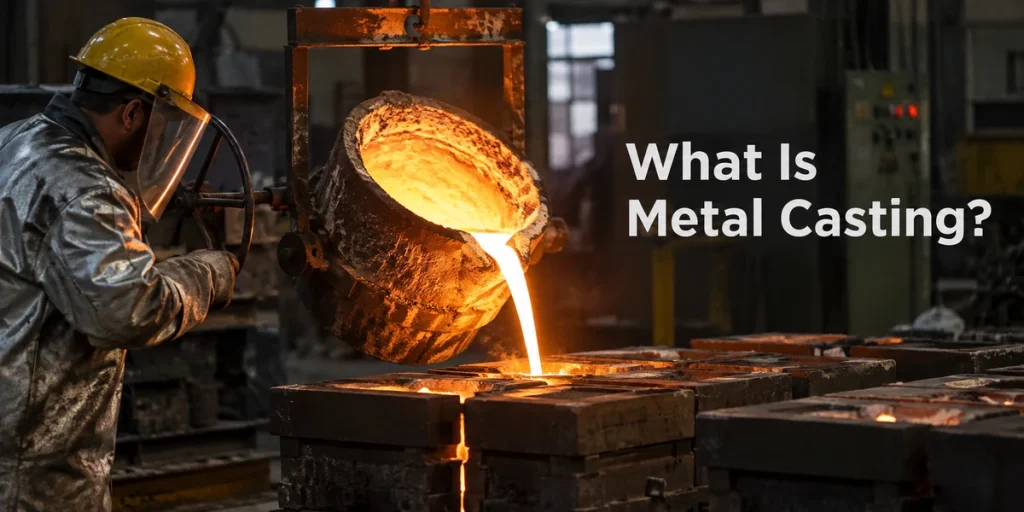
Metal casting is the process of melting metal, transferring it into a mold and allowing it to solidify into the required shape. After the casting leaves the mold, it may still require heat treatment, grinding, blasting, machining, coating or inspection before it becomes a usable component.
That last part is worth paying attention to.
A purchasing department may think it is buying a casting. The assembly plant may actually need a finished component with machined bores, controlled datums and inspection records.
Those are not quite the same purchase.
The process also changes considerably depending on the part. Investment casting works well for relatively detailed steel components. Sand casting is often more practical for larger iron or steel parts. Pressure die casting belongs mainly to high-volume aluminum, zinc and magnesium production.
So when somebody asks for a “good casting factory in China,” process selection should come before the supplier list.
Which Casting Process Should You Use?
The drawing usually narrows the choices quickly.
Process | Usually Makes Sense For | Where I Would Be Careful |
Detailed steel or stainless parts | Large simple components | |
Sand Casting | Heavy iron and steel parts | Fine surfaces without machining |
Shell Mold Casting | Medium parts needing better finish | Very large components |
Die Casting | High-volume aluminum or zinc parts | Low-volume steel projects |
Lost Foam Casting | Complex larger iron/steel shapes | Projects with weak process control |
Permanent Mold Casting | Repeated non-ferrous production | Very complex internal geometry |
There is a habit in sourcing to repeat the manufacturing method used by the previous supplier.
That can be expensive.
I have seen drawings described as “investment casting parts” even though nearly every functional surface was machined afterward. Once the annual volume and machining allowance were reviewed, the original casting process was no longer obviously the best choice.
The same happens in the other direction. A buyer moves a relatively complex part to sand casting to save money and then spends the saving on grinding and machining.
The casting process should solve the component, not follow the RFQ title.
Why Buyers Source Metal Castings from China
Price still matters, obviously. But low hourly labor cost is not the whole explanation anymore.
The bigger advantage is the concentration of supporting processes.
A foundry project may require pattern making, wax tooling, heat treatment, shot blasting, machining, surface treatment, testing and export packaging. In many Chinese manufacturing regions, those processes are available within an established industrial network.
That can shorten development work and make custom projects easier to manage.
It can also hide subcontracting.
One supplier may pour the casting itself but outsource heat treatment and machining. Another may machine in-house but buy raw castings from a separate foundry.
Neither arrangement is automatically bad. The buyer simply needs to know who owns each operation.
That question becomes much more important when a dimension fails.
Top 10 Metal Casting Foundries in China
1. Fuchun Precision Casting
Fuchun is the company I would look at early when the RFQ begins with a drawing rather than a catalogue part number.
Its position is different from a very large automotive foundry. Fuchun is more relevant to custom industrial components in carbon steel, alloy steel, stainless steel and ductile iron, particularly when the project moves from casting into machining.
A typical job may be an equipment housing with several machined faces, a heat-treatment requirement and two dimensions that actually matter to assembly. The raw casting itself is only one stage of the job.
This is where having casting and machining handled within the same project becomes useful.
Consider a fairly ordinary problem. A casting passes its initial dimensional inspection, then moves into machining. After heat treatment, two bores no longer hold their expected position. If the foundry and machine shop are separate companies, each can argue that its own operation followed the drawing.
The buyer is still left with unusable parts.
Fuchun makes more sense when the customer wants one manufacturing partner to take responsibility for a larger portion of that sequence.
It is not the obvious supplier for every project. A very large aluminum die-casting program belongs somewhere else, and a buyer needing millions of automotive parts will probably want a different production environment.
For custom ferrous castings with machining, however, Fuchun fits the job well.
2. Impro Precision Industries
Impro operates at a much larger scale and covers precision casting, sand casting, machining and other manufacturing processes.
I would associate it more with recurring industrial programs that justify formal supplier qualification and a fairly structured production environment.
For aerospace, automotive and technically demanding industrial work, that scale can be valuable.
For a small custom order of a relatively simple bracket, it may be more factory than the buyer actually needs.
3. Dawang Metals
Dawang is useful when the process has not been fixed yet.
Its broad casting capability means a buyer can discuss investment casting, sand casting and other manufacturing routes without immediately moving to another supplier.
That is valuable on heavier industrial parts.
I would still want the quotation to explain why one process was selected over another. A supplier offering many technologies is only useful if somebody inside the company is willing to tell the buyer that the original process assumption was wrong.
4. Ningbo Investment Casting
This is a more straightforward recommendation.
If the part is a steel or stainless precision casting and lost-wax manufacturing already makes sense, a specialist such as Ningbo Investment Casting belongs on the shortlist.
There is no need to force every project into a giant multi-process manufacturing group.
For some parts, a focused foundry is easier to evaluate.
5. Dandong Foundry
Dandong is much more interesting for gray-iron and ductile-iron work than for small stainless components.
Think machinery housings, pump parts, brackets and similar industrial castings.
For these jobs, experience with iron chemistry, molding and machining matters more than having investment casting listed on the website.
If the drawing is a stainless-steel precision component, I would move on.
6. CFS Foundry
CFS combines investment casting, die casting and machining.
That makes it useful for buyers managing several product families rather than a single type of casting.
The only question I would ask early is which process the factory performs most frequently for parts similar to mine.
A supplier can technically offer many things while still being much better at two of them.
7. RMC Casting Foundry
RMC has a broad process range and is particularly interesting when sand casting or larger iron and steel parts are involved.
The range is wide enough that buyers should be quite specific during the RFQ.
I am not particularly impressed by a website showing ten manufacturing processes. I care more about which line will produce the actual part, which engineers will review the drawing and whether the reference projects look remotely similar.
That information is more useful than the process count.
8. EMP Tech
EMP belongs in this list because aluminum die casting is too important to ignore.
This is a very different business from steel investment casting.
If the project involves an aluminum automotive housing, electronics enclosure or another higher-volume lightweight component, EMP becomes much more relevant than several companies above it.
For a ductile-iron casting, there is no reason to contact it.
9. Sunrise Metal
Sunrise also focuses heavily on aluminum die casting, machining and related finishing.
I would consider it where the project needs a combination of tooling, aluminum casting and finished machining rather than simply a raw die-cast part.
It is a useful reminder that “best Chinese foundry” is not really a single category.
A good aluminum die caster and a good steel investment foundry solve different problems.
10. Yide Casting
Yide is a sensible option for conventional gray-iron and ductile-iron components.
I would keep the recommendation simple.
Pump housings, agricultural machinery parts, forklift components and ordinary industrial iron castings fit the profile. Stainless investment castings and aluminum pressure die castings do not.
There is no benefit in making the shortlist more complicated than that.
How Should You Choose a Metal Casting Foundry in China?
Start with the production route.
Then ask about material experience.
After that, look at machining and inspection.
Factory size comes later.
One of the easiest sourcing mistakes is choosing a supplier because it looks impressive rather than because it repeatedly makes the same type of part.
Another mistake is comparing only raw-casting prices.
Suppose Supplier A quotes the casting 8% lower. Supplier B includes a slightly larger machining allowance and more stable fixture points. The first supplier wins the RFQ.
Three weeks later, the machine shop spends additional time correcting inconsistent stock and several parts fail a finished dimension.
The original 8% saving disappears.
No dramatic disaster occurred. The quotation was simply comparing the wrong stage of production.
For machined castings, ask who establishes the datums, who machines the part and who signs the final dimensional report.
Those three answers tell you quite a lot.
What Should You Send With an RFQ?
A 3D file is useful, but it is not enough by itself.
The supplier should normally receive the 2D drawing, material specification, expected order quantity and any heat-treatment or surface requirements. Critical dimensions should be clear.
If some dimensions are genuinely important to assembly, identify them.
Do not make every dimension unnecessarily tight just because modern CAD makes tolerances easy to type.
Foundries notice this.
One supplier may simply quote the drawing exactly as received. A more useful engineer may call and ask whether a tolerance on a non-functional face really needs to be held after casting.
That conversation can reduce cost before tooling exists.
What Usually Goes Wrong?
Casting problems are not always dramatic metallurgical failures.
Sometimes the wrong revision reaches production.
A buyer approves Rev. C during sampling. Months later, the production team discovers that an old Rev. B print remained attached to the tooling record. The foundry then produces parts that are internally consistent but technically obsolete.
The argument becomes awkward because nobody can point to a cracked casting or failed material certificate.
The document system failed before the metal was poured.
Other problems are equally ordinary: machining allowance was never agreed, heat treatment was outsourced without clear traceability, or the sample batch received far more inspection attention than routine production.
A beautiful sample is useful.
The tenth production batch is more interesting.
How Much Does Metal Casting Cost in China?
There is no meaningful single price per kilogram.
Material weight matters, but tooling, yield, heat treatment, machining, inspection, surface finishing and scrap can easily change the final cost.
A small stainless part with extensive machining may cost much more per kilogram than a large simple iron casting.
This is why I prefer comparing finished-component cost when possible.
If one foundry quotes only the raw part and another includes machining, dimensional inspection and packaging, their numbers are not competing quotations yet.
They are different products.
Raw Casting or Finished Machined Part?
There is no universal answer.
A buyer with an established machining operation may prefer raw castings. That allows it to control the final datums, fixtures and dimensional inspection itself.
For overseas sourcing, finished machining can simplify the project.
This is especially true when the critical dimensions are closely related to the casting geometry.
Splitting the work between two unrelated factories creates another interface where responsibility can become unclear.
That does not mean everything must be done under one roof. It means somebody should clearly own the finished component.
FAQ About Chinese Metal Casting
Can a Chinese foundry manufacture directly from my drawing?
Yes. For a serious quotation, send a 2D drawing, preferably a 3D model, the material grade, expected volume and any special heat-treatment or inspection requirements.
Should I buy raw castings or machined parts?
Buy raw castings if your own machining operation offers a clear advantage. Otherwise, asking the foundry to quote both raw and finished parts makes comparison easier.
How do I verify a foundry before production?
Review the production route that will actually be used for your part. Check material control, machining responsibility, inspection records and drawing revision control. For important projects, first-article inspection and a factory audit are worth more than a polished company presentation.
Final Thoughts
Before paying a deposit, I would want four answers: who pours the metal, who machines the component, which drawing revision controls production and what inspection record will be supplied with the first batch.
Those are ordinary questions.
If the answers are already vague during the RFQ stage, they rarely become clearer after production starts.
 English
  Spanish
  Portuguese
  French
  German
  Italian
  Arabic
  Russian
  Korean
  Japanese
  Indonesian
  Chinese