
Table of Contents
In a conventional sand foundry, the condition of the molding sand can affect nearly everything that follows. Moisture, compaction, binder content, and pattern wear may all influence the finished casting.
V-Process casting takes a different approach. Instead of relying on clay or resin to hold the sand together, it uses dry sand enclosed by plastic film. A vacuum keeps the mold rigid until the metal has solidified.
The method sounds simple. Making it work reliably, particularly with large metal castings, requires careful control of the film, vacuum system, sand packing, and pouring conditions.
For manufacturers comparing casting processes, the real question is not whether V-Process casting produces a better-looking surface. It is whether its molding characteristics can reduce production difficulties and the cost of the finished component.
What Is V-Process Casting?
V-Process casting, also known as vacuum sealed molding, is a sand casting method developed in Japan in the early 1970s.
The process uses dry, unbonded sand contained between plastic films. When air is evacuated from the mold, atmospheric pressure presses the sand grains together and maintains the shape of the casting cavity.
The sand itself does not undergo a chemical hardening reaction.
This is the fundamental difference between V-Process casting and conventional green sand or resin sand casting.
In green sand molding, clay and moisture provide the bonding action. In no-bake molding, chemical binders harden the sand. With the V-Process, mold strength depends on maintaining a pressure difference between the inside of the sealed sand mold and the surrounding atmosphere.
Release the vacuum at the appropriate stage, and the sand becomes free-flowing again.
That difference affects pattern wear, mold handling, shakeout, and sand reuse.
It also introduces a risk that conventional sand molds do not share to the same extent: a loss of vacuum can compromise mold stability.
How V-Process Casting Actually Works
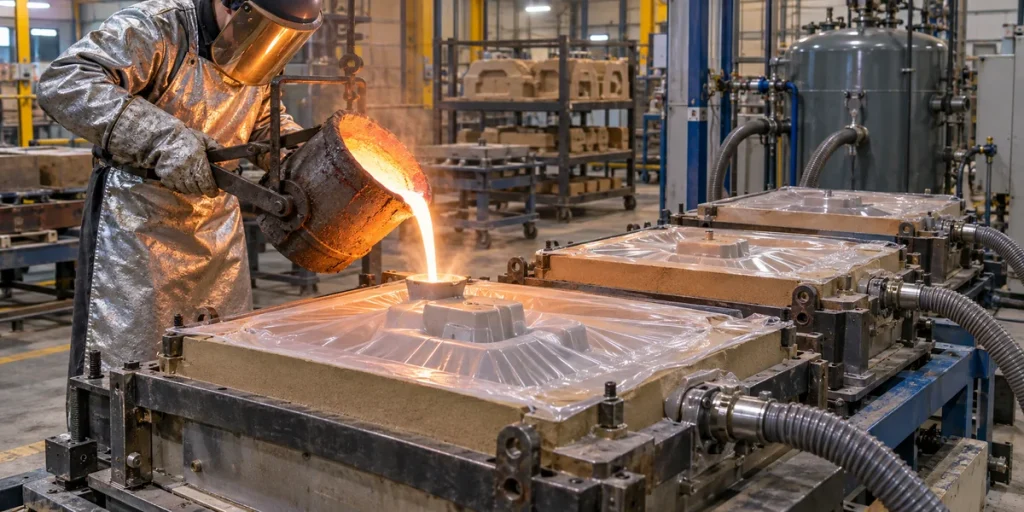
The process begins with a pattern mounted on a specially designed plate. Small vents connect the pattern surface to a vacuum chamber beneath it.
A thin thermoplastic film is heated until it becomes flexible enough to follow the pattern’s contours.
When vacuum is applied through the pattern plate, the softened film is drawn tightly against the surface.
Getting this first stage right is important. If the film bridges a recessed area instead of following its shape, the resulting mold will reproduce the wrong geometry. Excessive stretching may also cause tearing around corners.
Once the film is in place, a molding flask is positioned over the pattern.
Dry sand is poured into the flask and settled by vibration. The vibration helps the sand fill spaces around the pattern without the mechanical ramming normally associated with some bonded-sand molding methods.
A second film seals the exposed surface.
Air is then extracted through channels in the flask. Atmospheric pressure compresses the enclosed sand, creating a mold rigid enough to handle.
The pattern is withdrawn while vacuum is maintained.
The second mold half is prepared in the same way. After assembly, the mold is ready for pouring.
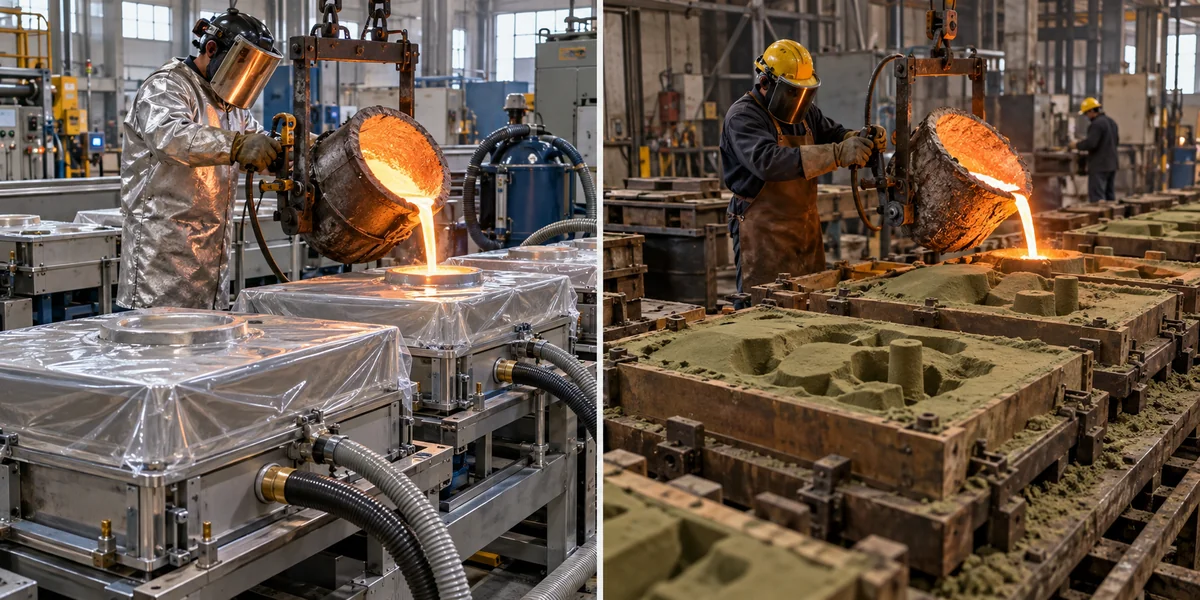
Molten metal enters the cavity through a designed gating system. The cavity must fill while gases generated during pouring have a suitable escape route.
The vacuum remains active while the casting solidifies sufficiently to retain its shape.
Only then is the pressure difference removed.
Without vacuum support, the sand no longer holds together. It falls away from the casting, eliminating much of the mechanical effort normally required during shakeout.
The casting can then be cleaned, inspected, heat-treated, or machined according to the drawing.
Why Vacuum Control Matters
The vacuum system is both the defining feature of the process and one of its main operating concerns.
A mold can appear stable immediately after preparation but lose rigidity if a film becomes damaged or a connection develops a leak.
Possible leakage points include film joints, flask seals, hoses, and vacuum distribution channels.
The consequences depend on when the pressure is lost.
During mold handling, insufficient vacuum can cause the sand to move or the mold to lose its shape. During pouring, instability becomes more serious because molten metal is already entering the cavity.
Foundries therefore need reliable pressure monitoring, sealing arrangements, and maintenance procedures.
Film selection matters as well.
A film must soften enough to conform to the pattern but retain sufficient integrity during mold preparation. Deep recesses and sharp transitions are troublesome because the material may stretch unevenly.
Sand packing introduces another variable. Poor vibration can leave areas inadequately settled, while the vacuum system must distribute suction throughout the mold.
These details explain why two foundries using the same basic V-Process principle may achieve different results.
V-Process Casting Advantages and Trade-Offs
Surface Quality and Pattern Life
The plastic film creates a barrier between the reusable pattern and molding sand.
In conventional molding, repeated contact with abrasive sand can gradually wear pattern surfaces. This contact is greatly reduced in vacuum molding.
The pattern may therefore remain serviceable for longer production runs.
The film also influences the surface reproduced in the casting cavity. A properly formed film can produce a smooth mold face, although wrinkles, tears, or poor sand selection can create defects of their own.
For large castings with extensive exposed surfaces, the difference may be noticeable during cleaning and grinding.
Less finishing work can matter more than a small difference in the initial casting price.
Sand Recovery Is Simpler, Not Effortless
One useful feature of the V-Process is that the molding sand contains no conventional clay or resin binder.
After vacuum release, the sand separates relatively easily from the casting.
There is no hardened mass of chemically bonded molding sand to break apart.
However, used sand cannot simply be returned to production without proper handling.
Metal fragments, dust, degraded film residues, and accumulated heat must be managed. Sand grain condition and cleanliness also affect subsequent mold performance.
The process can reduce certain binder-related emissions and waste-treatment requirements, but it does not eliminate environmental or occupational hazards.
Silica dust, film decomposition products, and fumes from molten metal still require suitable extraction and ventilation.
Tooling Costs Depend on Production Requirements
Pattern wear may be lower, but a V-Process installation requires specialized equipment.
Vacuum-compatible flasks, pumps, film heaters, vibration equipment, and sand handling systems all contribute to manufacturing costs.
Mold preparation also involves steps that are unnecessary in some conventional molding operations.
For a high-volume production line manufacturing simple iron components, automated green sand casting may offer a shorter and more economical molding cycle.
For a large casting requiring substantial surface finishing, V-Process molding may provide a different cost advantage.
Neither conclusion is reliable without examining the part.
The total cost depends on tooling, molding time, metal yield, finishing operations, inspection, and rejected components.
V-Process Casting vs. Green Sand Casting
Manufacturing factor | V-Process Casting | Green Sand Casting |
Mold stability | Vacuum pressure | Clay-bonded sand |
Sand condition | Dry, unbonded | Moist, clay-bonded |
Pattern contact | Separated by film | Direct sand contact |
Vacuum equipment | Required | Generally unnecessary |
Shakeout | Sand flows away after vacuum release | Mechanical shakeout commonly used |
Sand reuse | Cooling and cleaning required | Sand conditioning required |
Suitable production | Depends on casting size and geometry | Broad range, including automated high-volume production |
The comparison is not simply about surface finish.
Consider a factory purchasing 20 large machinery housings each year. The amount of machining required after casting may have a considerable influence on the finished price.
Now consider an automotive supplier purchasing 20,000 relatively simple iron brackets.
A fast green sand molding line may be a better fit for the second program, even if the V-Process can technically produce the part.
The same drawing can lead to different process decisions when annual volume changes.
Materials and Typical Applications
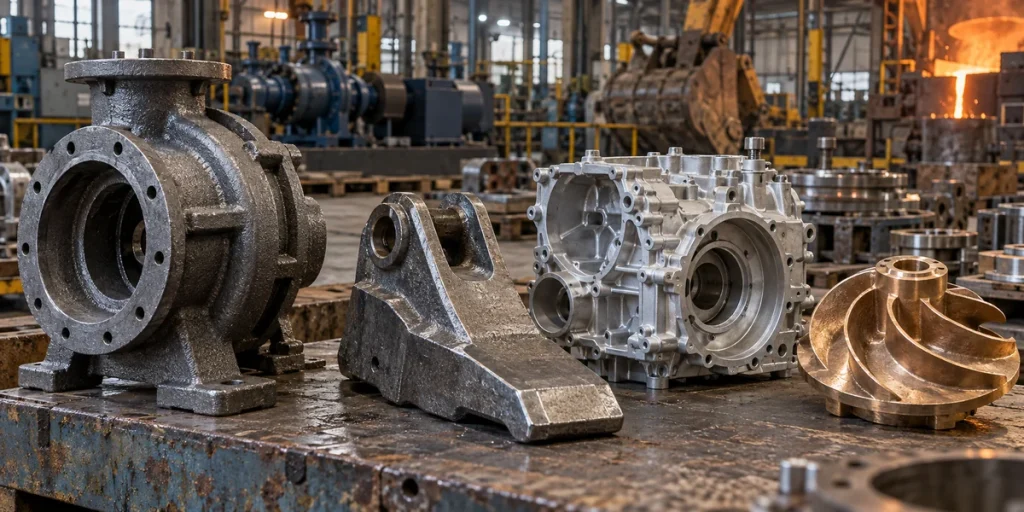
V-Process casting can be used with various ferrous and nonferrous alloys, provided the foundry has the necessary melting equipment and process experience.
Gray iron is commonly associated with machinery components where machinability and vibration damping are useful.
Ductile iron offers different strength and toughness characteristics and is used in equipment exposed to higher mechanical loads.
Steel castings may be selected for wear parts, structural components, or machinery operating under demanding conditions.
Aluminum and copper-based alloys are also possible, although not every vacuum molding foundry processes these materials.
The application is best understood through component geometry rather than industry labels alone.
Machinery Housings and Equipment Bases
Large machinery components often combine thick structural areas with machined mounting surfaces.
The casting must remain sufficiently stable during solidification while retaining enough material for final machining.
V-Process molding may help maintain mold consistency, but it does not remove the need for feeding design or machining allowances.
Mining and Wear Components
Wear plates and equipment liners are another established application.
These components may contain broad surfaces, ribs, or geometries where reducing grinding and cleaning work is valuable.
A documented industrial application involved vacuum molding equipment installed for wear-plate manufacturing, where the producer reported a substantial reduction in labor-intensive finishing.
That result reflects one production case and should not be treated as a general savings guarantee.
Agricultural and Construction Equipment
Cast parts used in agricultural and construction machinery may require strength, wear resistance, or complex external shapes.
Vacuum molding can be considered for selected components, but the appropriate alloy and heat treatment remain central to the finished part’s performance.
A vacuum-formed mold does not make an unsuitable material more wear-resistant.
Design Considerations Before Tooling
The first design issue is whether the plastic film can follow the pattern.
Deep pockets, abrupt corners, and complicated undercuts may require changes to the geometry or a different core arrangement.
Draft requirements can sometimes be reduced because the pattern is separated from sand by the film. That does not mean every pattern can be produced without draft.
The second issue is metal solidification.
Thin walls and heavy sections create different problems. A thin section may freeze before the cavity fills. A heavy junction may remain molten longer than the surrounding material, increasing the risk of shrinkage porosity.
V-Process molding changes how the sand mold is held together; it does not change the fundamental behavior of solidifying metal.
Gating and riser design must also account for the pressure conditions around the mold cavity. The vacuum used to stabilize the sand should not be confused with a vacuum-assisted metal filling process.
Finally, identify the surfaces that will be machined.
Bearing seats, sealing faces, threaded holes, and other critical features usually require dimensional controls that go beyond ordinary as-cast accuracy.
What to Ask a V-Process Foundry
A useful quotation starts with a complete drawing, material specification, and production estimate.
The supplier should be able to explain whether the component fits its molding flasks, pouring equipment, and handling capacity.
For a casting containing large cavities or difficult corners, ask how the film will be formed and whether separate cores are needed.
For heavy sections, discuss the feeding arrangement and the possibility of shrinkage defects.
Also confirm what the quotation includes.
A price for an unmachined casting is not directly comparable with a quotation covering CNC machining, heat treatment, dimensional inspection, and protective coating.
Tooling ownership, sample approval, packaging, and delivery arrangements deserve attention before an international order is placed.
Inspection requirements should reflect the component’s function. A decorative panel and a pressure-containing industrial part do not require the same quality assurance plan.
Frequently Asked Questions
What Happens If Vacuum Is Lost During Casting?
A significant vacuum loss can reduce the rigidity of the sand mold. Depending on the timing and severity, this may cause deformation, sand movement, or casting defects.
Can V-Process Casting Produce Thin Walls?
Certain thin-walled components can be produced, but feasibility depends on alloy fluidity, casting dimensions, gating design, and the foundry’s capabilities. Film forming and metal filling must both be considered.
Is V-Process Casting the Same as Vacuum Die Casting?
No. V-Process casting uses vacuum to stabilize an expendable sand mold. Vacuum die casting generally uses vacuum assistance to remove gases from a metal die cavity during filling.
Conclusion
V-Process casting is most useful when its mold characteristics solve a specific manufacturing problem.
Reduced pattern wear, straightforward shakeout, and good surface quality may all contribute to lower finishing costs. At the same time, film forming, vacuum reliability, and equipment requirements introduce their own constraints.
For an industrial buyer, the most productive starting point is the component drawing.
Check the alloy, size, wall thickness, machining requirements, and annual volume. Then compare V-Process molding against conventional sand casting using the total cost of a finished, inspected part—not simply the price of pouring the metal.
Related Post might be HELPFUL to you: What Is Casting of Metal?
 English
 Spanish
 Portuguese
 French
 German
 Italian
 Arabic
 Russian
 Korean
 Japanese
 Indonesian
 Chinese