
Table of Contents
Rust removal sounds simple until the wrong cleaning method damages a surface that was still perfectly usable. I have seen old steel parts cleaned successfully with little more than a wire brush and oil, and I have also seen good components attacked so aggressively with a grinder that the corrosion became the least important problem. For most jobs, the basic rule is straightforward: treat light rust gently, use mechanical or stronger chemical methods for heavy corrosion, and protect bare metal soon after cleaning. Stainless steel, cast iron, tools and machined components should not all be treated in exactly the same way.
Before starting, look at the part rather than just the color of the rust. Orange staining on the surface is one thing. Deep pitting around a sealing face, bolt hole or load-bearing section is another. Removing the rust will not put missing metal back.
Does Vinegar Remove Rust?
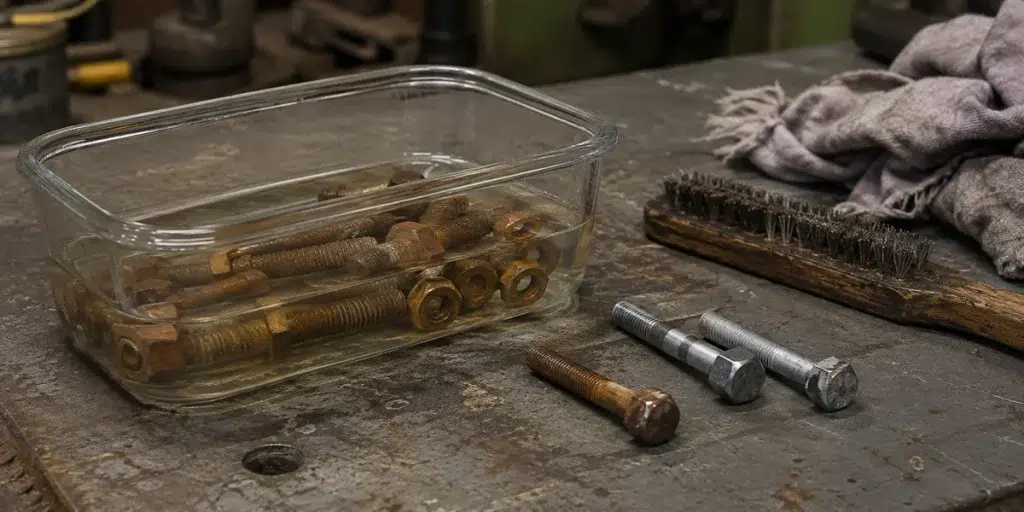
Yes, vinegar removes rust from ordinary steel and iron, particularly when the corrosion is still relatively light.
For bolts, old hand tools and small components, white vinegar is often convenient because the liquid can reach threads and corners that are awkward to clean with sandpaper. The acetic acid gradually loosens iron oxide, after which the part can usually be brushed clean.
I still would not make vinegar my first choice for an expensive production component.
The reason is control. Vinegar does not stop working simply because the orange material has disappeared. Leave steel in an acidic bath for too long and the solution may begin attacking the metal underneath. On an old wrench, that may not matter much. On a machined component with a controlled diameter or sealing surface, it certainly can.
If you use vinegar, check the part rather than relying on an arbitrary overnight soaking time. Brush away the loosened rust, rinse it, dry it thoroughly and add corrosion protection soon afterward.
How to Remove Rust from Metal with Baking Soda?
Baking soda is better for mild staining than serious corrosion.
Mix it with enough water to form a paste, cover the rusty area and scrub after it has had time to sit. A nylon pad, toothbrush or small brush works well on many household parts.
The attraction is that the treatment is fairly easy to control. You are working on the affected area rather than dropping the entire part into an acid bath.
Once rust begins flaking in layers, though, I would stop reaching for baking soda. It can become one of those jobs where twenty minutes of patient scrubbing achieves what a wire brush could have done in two.
What Is the Fastest Way to Remove Rust from Metal?
For a thick steel bracket or plate, the fastest answer is often mechanical: a wire wheel, abrasive disc, needle scaler or blasting process.
For a precision component, the answer changes.
We once dealt with the sort of problem that looks harmless at first. Several rusty components had been cleaned before inspection. Most were fine, but two locating edges had been worked much harder than the rest of the parts. Whoever cleaned them had clearly wanted every trace of discoloration gone. They succeeded. Unfortunately, enough material disappeared around those edges to create trouble during the next operation.
That is why I am wary of the phrase “fastest rust remover.”
Production people usually care about the condition of the part after cleaning, not how quickly the orange color disappeared. If the surface is dimensional, threaded, polished or used for sealing, slower and controlled can be cheaper.
How to Remove Heavy Rust from Metal?
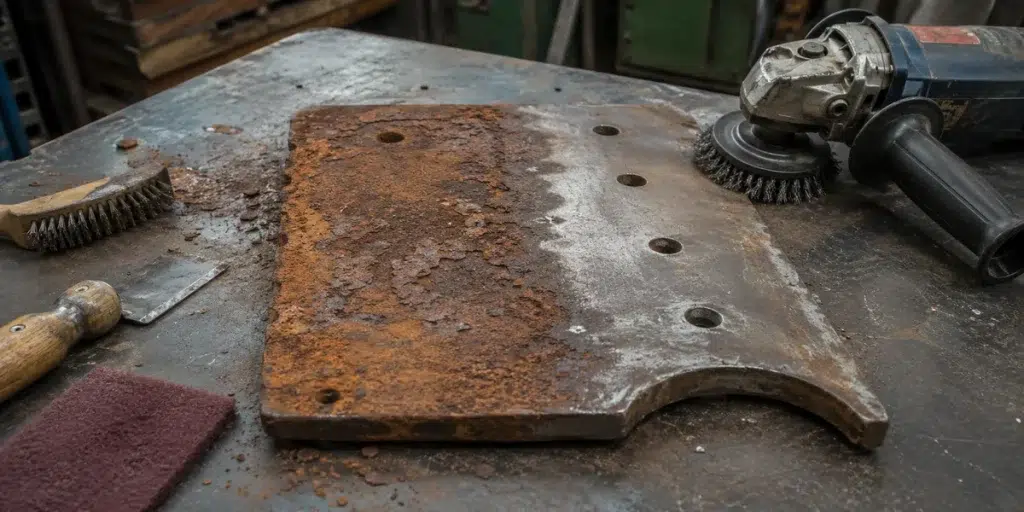
Heavy rust usually has to be removed in stages.
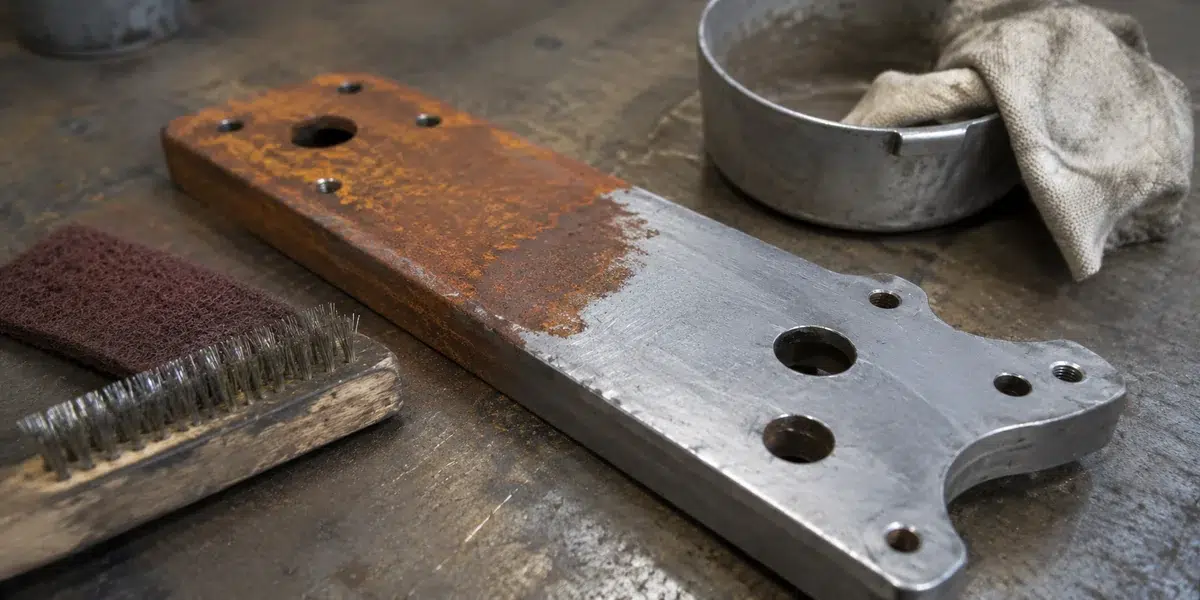
Loose flakes and scale should come off first. A hand wire brush may be enough for a small casting, while larger fabricated parts can justify powered brushing, grinding or abrasive blasting.
Then stop and look at what is left.
This inspection is sometimes skipped because everyone is pleased to see clean gray metal appearing again. Deep pits are more important than the remaining color. A structural bracket that has lost a meaningful amount of section thickness cannot be restored simply by painting over a clean surface.
For machinery and industrial castings, abrasive blasting is often efficient because it reaches irregular surfaces better than a grinding disc. It does, however, change the surface profile. That may be desirable before painting but undesirable on a finished mating surface.
I would separate critical machined areas before cleaning whenever possible rather than asking one aggressive process to treat the entire component equally.
How to Remove Rust from Stainless Steel?
Stainless steel is corrosion-resistant, not corrosion-proof.
Light orange spots can appear because of chloride exposure, damaged passive surfaces or contamination from ordinary carbon steel. The last one is particularly common in workshops.
An operator uses the same wire brush on a mild-steel fabrication and then on stainless steel. A few days later, small orange spots appear and everybody starts questioning the stainless grade.
Sometimes the stainless steel is not the real problem at all.
Start gently with detergent, water and a nylon pad. For more stubborn contamination, use products and tools intended for stainless steel. If brushing is required, use a stainless-steel brush that has not been used on carbon steel.
Personally, I think separate stainless cleaning tools are one of those boring workshop habits that save far more trouble than they cost.
Avoid ordinary steel wool on finished stainless surfaces. It may leave behind tiny iron particles that later corrode.
How to Remove Rust from Cast Iron?
Cast iron is less forgiving about being left wet after cleaning.
A stiff brush works well on light corrosion. Heavier scale on industrial castings may need powered brushing, blasting or another mechanical method. Chemical treatment is possible too, especially on smaller pieces, but the surface must be dried properly afterward.
Freshly cleaned cast iron can begin showing rust again surprisingly fast in a humid workshop.
This is particularly noticeable on rough as-cast surfaces. Their texture holds moisture in small depressions where a smooth machined surface might dry more easily.
For cookware, the answer is usually re-seasoning. For industrial parts, use whatever protection the application actually requires: oil, temporary rust preventive, primer, paint, plating or another specified surface treatment.
How to Stop Rust from Going Black When Tabbing Out?
If by this phrase you mean rust turning black while it is being treated, the color change may be normal.
Many rust converters react with iron oxide and leave a dark brown, blue-black or nearly black surface. That does not necessarily mean corrosion has become worse. It may be the converted layer the product is designed to create.
Do not immediately sand it away just because the color changed. Check the instructions for the chemical being used and confirm whether the black layer is intended to remain before painting.
How to Remove Rust from Tools?
Old tools are where I am much less fussy.
A wrench with a little surface rust does not need laboratory treatment. Oil and an abrasive pad may be enough. More extensive corrosion can be treated with vinegar or a commercial remover, followed by brushing.
For garden tools and large steel hand tools, a wire wheel is often faster.
Moving parts deserve more attention than appearance. Pliers can look perfectly clean on the outside while the pivot still feels gritty. After rust removal, dry the joint, work it several times and add a suitable lubricant.
There is also a point where restoration stops making sense. A screwdriver with cosmetic corrosion is easy to save. A badly pitted wrench jaw or weakened cutting tool is different.
I would rather replace a cheap unsafe tool than celebrate how successfully its rust was removed.
Rust Converter vs Rust Remover?
These two products are often treated as interchangeable, but they solve different problems.
Method | What You Get | Where I Would Use It |
Rust remover | Rust is dissolved or stripped away | Small parts, cleaner bare-metal finish |
Rust converter | Remaining rust becomes a more stable layer | Structures where perfect cleaning is difficult |
Mechanical removal | Rust and loose scale are physically removed | Heavy corrosion and large components |
Abrasive blasting | Rapid, uniform surface preparation | Fabrications, castings and parts before coating |
I prefer rust remover when clean bare metal is realistically achievable.
Rust converter makes more sense on large frames, fabricated structures, pits and awkward areas where removing every trace of oxide would consume excessive time. But it is not magic paint for loose scale. Flaky material still needs to come off first.
A common mistake is applying converter over rust that can practically be scraped off with a finger. That is not surface preparation; it is postponing it.
How to Prevent Rust After Removing It?
People spend a great deal of time deciding how to remove rust and surprisingly little time deciding what happens fifteen minutes afterward.
That is backwards.
Bare carbon steel exposed to humidity can begin developing flash rust very quickly. A freshly blasted component left overnight in the wrong environment may need to be cleaned again the following morning.
The protection depends on the job. Workshop tools may only need a film of oil. Machinery components might use a temporary rust preventive before assembly. Outdoor steel could require primer and paint, while production parts may use powder coating, zinc plating, galvanizing or another specified finish.
Storage and packaging matter as well. We have seen metal components leave a factory clean and arrive with corrosion because moisture was trapped inside export packaging. The manufacturing process was fine; the shipping environment was not.
For precision parts, also consider machining coolant, fingerprints, washing residues and drying. Corrosion problems do not always begin outdoors.
One final point is worth keeping in mind. A rusty part can look terrible and still be structurally sound, while another part may look almost clean but contain deep pits exactly where a seal or bearing sits. Appearance alone is a poor inspection standard.
Remove the corrosion carefully, inspect what remains, and then decide whether the part needs protection, repair or replacement. That sequence usually saves more trouble than simply choosing the strongest rust remover available.
 English
  Spanish
  Portuguese
  French
  German
  Italian
  Arabic
  Russian
  Korean
  Japanese
  Indonesian
  Chinese