
Table of Contents
Technical article
A casting may look almost complete when it comes out of the mold, yet a closer inspection reveals a thin seam running across the surface or an edge that has not formed properly. These problems are often associated with the way molten metal moves through the mold during pouring.
Cold shuts and misruns are two common examples. Both can occur when metal loses its ability to flow before the mold is completely filled, but the defects develop in different ways. A cold shut forms when separate streams of molten metal meet without properly fusing. A misrun occurs when the metal stops flowing before reaching the remaining sections of the mold cavity.
For foundry engineers, identifying the difference is important. Adjusting pouring temperature alone may not solve the problem. The gating layout, component geometry, mold conditions, and pouring practice all deserve attention when investigating recurring defects.
1. What Is a Cold Shut in Casting?
A cold shut develops when two streams of molten metal meet inside the mold but fail to form a continuous bond. Instead of merging into one solid mass, the streams leave a visible boundary where they come together.
On a finished component, this defect usually appears as a thin line, seam, or narrow groove. It may be found around corners, ribs, junctions, or other areas where the metal flow divides and later reconnects.
The condition of the metal surfaces plays an important role. As molten metal travels through the mold, its temperature gradually decreases. Oxide films may also form on the exposed metal surfaces. When two relatively cool flow fronts meet, these surface layers can interfere with proper fusion.
The result is a discontinuity within the casting. Depending on its depth and location, a cold shut may be little more than a surface imperfection or a serious quality concern.
This distinction matters particularly for components that carry loads, contain pressurized fluids, or experience repeated mechanical stress. A casting that passes a basic visual inspection may still require further examination if a suspected cold shut appears in a critical area.
2. What Is a Misrun in Casting?
A misrun occurs when molten metal solidifies before the mold cavity has been completely filled. Unlike a cold shut, where metal streams meet but fail to fuse, a misrun means that the metal never reaches part of the intended casting geometry.
The defect is usually easy to recognize. An edge may be missing, a corner may appear rounded or incomplete, or a thin section may not have formed at all.
Consider a casting with several narrow ribs extending from a thicker central body. The main body may fill without difficulty, while the metal entering the ribs loses heat too quickly to reach their ends. The finished part will have incomplete sections even though the pouring operation appeared normal.
The length of the flow path is another factor worth considering. Metal traveling through a long, narrow passage has more opportunity to lose heat than metal entering a relatively thick section. A gating system that restricts flow can make the situation worse.
Misruns are therefore closely associated with the relationship between metal temperature, filling time, wall thickness, and the geometry of the component.
3. Cold Shut vs. Misrun: What Is the Difference?
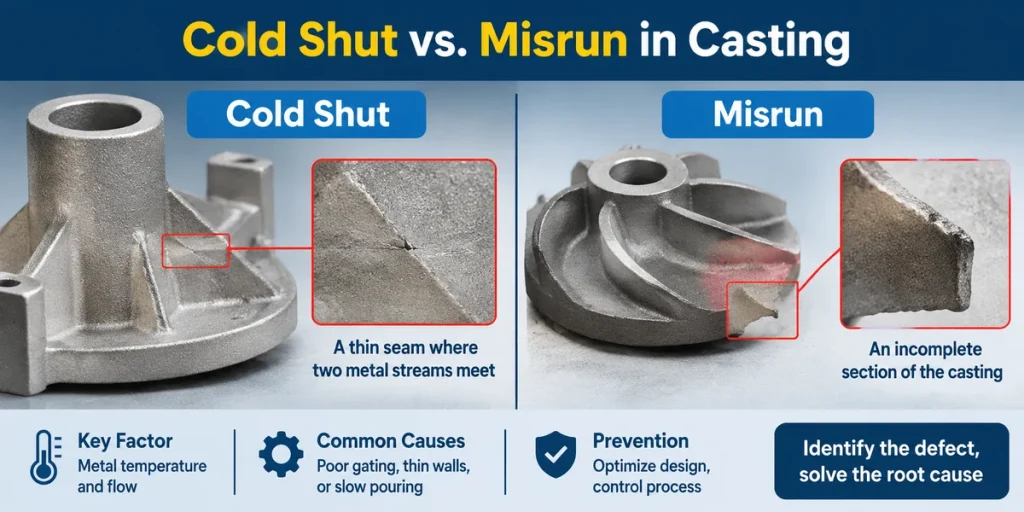
Although both defects are related to metal flow and premature cooling, their physical characteristics are different.
Comparison | Cold Shut | Misrun |
Formation | Two metal streams meet but do not fuse | Metal solidifies before filling the cavity |
Main appearance | Thin seam, line, or groove | Missing or incomplete casting section |
Typical location | Where separate flow fronts reconnect | Far ends of flow paths and thin sections |
Main issue | Incomplete bonding between metal fronts | Insufficient mold filling |
Common contributing factors | Low metal temperature, oxide films, unfavorable flow conditions | Short filling time, low fluidity, restricted flow |
Inspection focus | Surface continuity and defect depth | Missing geometry and dimensional accuracy |
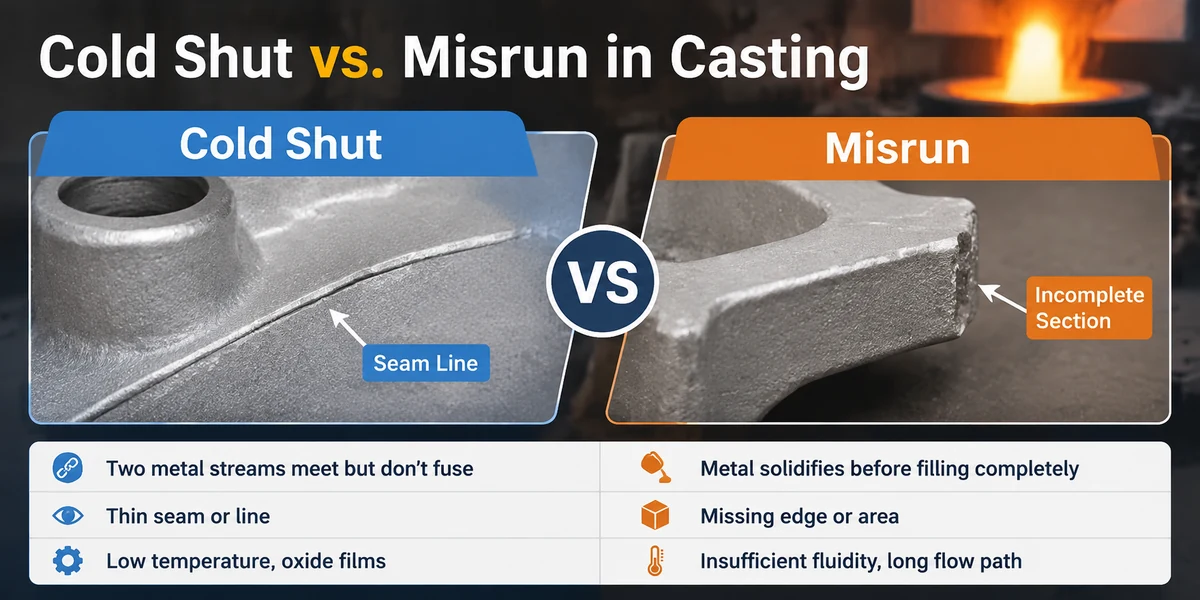
One useful way to distinguish them is to look at the shape of the affected area. A narrow line running across an otherwise complete casting may indicate a cold shut. An unfinished edge or missing portion of the component is more consistent with a misrun.
There are situations where the two defects occur close together. For example, two metal fronts may meet near the end of a thin section after losing considerable heat. A cold shut can form at the junction, while another part of the same component may remain incompletely filled.
The defect should therefore be assessed according to its actual appearance and formation mechanism, rather than classified by location alone.
4. Why Do Cold Shuts and Misruns Occur?
In foundry production, these defects rarely have just one possible cause. Temperature, flow behavior, mold conditions, and component design influence one another.
4.1 Molten Metal Temperature and Fluidity
Pouring temperature has a direct effect on how far molten metal can travel before solidification begins.
When the temperature is too low for the selected alloy and casting geometry, the metal may lose fluidity before reaching distant sections of the mold. In a thin-walled component, even a relatively small temperature drop can shorten the available filling time.
For cold shuts, the problem often becomes noticeable when separate metal fronts arrive at a junction without enough heat to fuse properly. For misruns, the metal simply stops flowing before the cavity is filled.
However, increasing the pouring temperature is not always the best answer. Excessive temperatures can increase oxidation, mold-metal reactions, and other casting problems. The correct operating range should be established according to the alloy, mold material, and casting requirements.
4.2 Gating System and Ingate Position
The gating system determines how molten metal enters the mold and distributes throughout the cavity.
Poorly positioned ingates can create uneven filling patterns. In some designs, the metal divides into several streams that travel along different paths before meeting again. If the flow fronts have cooled too much by that point, cold shuts may develop.
For misruns, narrow runners, restrictive ingates, or an inefficient layout may limit the amount of metal entering the cavity within the available filling time.
When a defect repeatedly appears in the same location, engineers should examine the relationship between the defect position and the ingate arrangement. A change in ingate position or runner dimensions may be more effective than simply raising the pouring temperature.
4.3 Pouring Speed and Filling Time
A slow or interrupted pouring operation gives the metal more time to lose heat inside the mold.
This is particularly important for castings with thin walls or long flow paths. The metal entering the cavity first may begin to solidify before the remaining material reaches the same area.
An inconsistent pouring rate can also cause separate metal fronts to arrive at different temperatures and times. Under unfavorable conditions, they may meet without forming a sound connection.
Maintaining a stable pouring rate is therefore important. In production lines with demanding filling requirements, automated pouring equipment can help reduce variations between casting cycles.
4.4 Wall Thickness and Component Geometry
Casting design has a considerable influence on filling performance.
Thin sections cool more rapidly because they have a relatively high surface-area-to-volume ratio. Long narrow passages, sharp transitions, and sudden changes in wall thickness can also make metal flow less predictable.
A component may fill successfully during initial trials but develop recurring misruns when production conditions vary slightly. This is one reason why casting design and process capability should be evaluated together rather than treated as separate issues.
Where possible, designers should avoid unnecessarily thin sections and abrupt changes in geometry. Smooth transitions can make it easier for molten metal to move through the mold.
4.5 Mold Temperature and Venting
A cold mold absorbs heat from incoming molten metal. If the mold temperature is unsuitable for the selected casting process, the metal may solidify before completing its journey through the cavity.
Venting is another part of the equation. Air and gases trapped inside the mold need a suitable escape route. Poor venting can create resistance to incoming metal and interfere with mold filling.
These conditions should be checked when defects continue to occur despite apparently acceptable pouring temperatures and metal supply.
5. How to Prevent Cold Shuts and Misruns
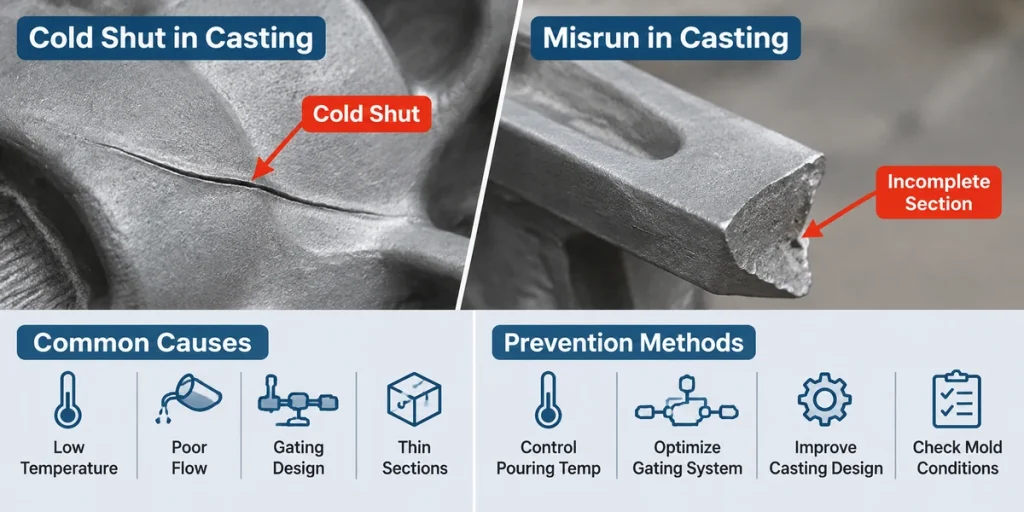
The most useful corrective action depends on where the defect appears and how consistently it occurs. A foundry should investigate the filling process before changing several production parameters at once.
Review the pouring temperature: Check the actual temperature of the metal near the pouring stage, not just the furnace setting. Temperature loss during transfer and holding can make a difference. Establish an appropriate range for the specific alloy and casting geometry.
Examine the gating layout: Look at the sprue, runner, and ingate arrangement. If cold shuts repeatedly appear where two streams reconnect, the filling sequence may need to be changed. For recurring misruns, the flow restrictions and metal delivery capacity should be reviewed.
Keep the pouring operation consistent: Avoid unnecessary interruptions and large variations in pouring speed. A stable filling operation gives metal less opportunity to cool unevenly inside the mold.
Check thin sections in the casting design: If misruns occur at the ends of narrow ribs or long extensions, review whether the wall thickness and flow distance are appropriate for the selected process. Design adjustments may be necessary when the geometry leaves very little time for filling.
Control mold conditions: Maintain suitable mold temperatures and inspect venting channels. In processes where preheating is appropriate, consistent mold preparation can help reduce excessive heat loss during filling.
Use trial castings to verify changes: After adjusting a process parameter, produce trial castings and compare the results. Record the defect location, pouring conditions, and inspection findings. This makes it easier to determine whether an adjustment has actually improved the process.
Changing several variables simultaneously makes troubleshooting more difficult because the source of improvement or failure becomes unclear.
6. How Foundries Identify and Investigate These Defects
Visual inspection is usually the first step. Experienced inspectors often begin by examining where the defect appears and whether the surrounding casting geometry is complete.
A cold shut generally leaves a narrow seam or groove on the surface. A misrun is more likely to produce a missing edge, incomplete corner, or section that does not match the drawing.
However, appearance alone cannot always establish the full extent of a defect. Depending on the component and its application, additional inspection methods may be required.
- Dimensional inspection: Checks whether the casting has been filled to the required dimensions and identifies missing sections.
- Dye penetrant testing: Can reveal surface-breaking discontinuities in suitable non-porous materials.
- Radiographic testing: May help assess internal discontinuities, depending on their orientation, size, and material thickness.
- Metallographic examination: A sectioned sample can provide more information about the interface and bonding condition of a suspected cold shut.
For critical components, the inspection method and acceptance criteria should follow the relevant product specifications and applicable standards. A defect should not be accepted or rejected based only on its appearance without considering its location and intended service conditions.
7. Practical Troubleshooting: Where Should Engineers Start?
When a casting defect appears repeatedly, its location often provides a useful starting point for investigation.
Inspection finding | Possible defect | Initial investigation |
Thin seam across an otherwise complete casting | Cold shut | Metal flow convergence and surface condition |
Missing edge or incomplete corner | Misrun | Filling time and flow restrictions |
Defect around thin ribs | Either | Wall thickness and local cooling |
Repeated seam at the same junction | Cold shut | Ingate position and filling sequence |
Incomplete filling at the far end | Misrun | Flow distance and metal delivery |
Defects appearing after changes in production conditions | Either | Pouring temperature, mold conditions, and pouring consistency |
For example, if a thin seam repeatedly appears at the same junction, it is worth reviewing how the metal reaches that area. Engineers can examine whether the streams arrive too far apart in time or have cooled excessively before meeting.
If the end of a long, narrow section remains incomplete, the investigation should focus more on filling capacity, local cooling, and gating restrictions.
These observations do not replace a proper defect assessment, but they can help narrow down the possible causes before production adjustments are made.
8. Frequently Asked Questions
Are cold shuts and misruns the same casting defect?
No. A cold shut occurs when separate metal streams meet but fail to fuse properly. A misrun occurs when molten metal solidifies before filling the entire mold cavity.
Can a cold shut affect the mechanical strength of a casting?
Yes. A cold shut can create a discontinuity in the casting and reduce its ability to withstand mechanical stress. The actual effect depends on its size, depth, location, and the service conditions of the component.
Why do misruns often appear in thin-walled castings?
Thin sections lose heat relatively quickly because of their high surface-area-to-volume ratio. If the metal cannot reach these areas before solidification begins, incomplete filling occurs.
Will increasing pouring temperature eliminate cold shuts?
Not necessarily. Higher temperatures may improve fluidity, but cold shuts can also be associated with oxide films, unfavorable flow patterns, and poor ingate positioning. The entire filling process needs to be considered.
Can cold shuts and misruns be repaired?
Repair depends on the alloy, defect location, component function, and applicable quality requirements. Some defects may be suitable for approved repair procedures, while others require rejection and remanufacturing. Pressure-bearing and safety-critical components require particular care.
Conclusion
Cold shuts and misruns offer different clues about what is happening during mold filling. A seam where two streams meet points toward a fusion problem, while an incomplete edge suggests that the metal did not reach the end of the cavity.
For foundry manufacturers, the location and appearance of a defect should guide the investigation. Reviewing metal temperature, gating design, pouring consistency, and component geometry is generally more useful than changing one production parameter without understanding the underlying cause.
A well-controlled casting process is not simply about filling the mold. It is about achieving consistent results across production batches while meeting the dimensional and performance requirements of the finished component.
 English
 Spanish
 Portuguese
 French
 German
 Italian
 Arabic
 Russian
 Korean
 Japanese
 Indonesian
 Chinese