
目录
A casting can look perfectly acceptable when it leaves the foundry and still cause problems weeks later. Porosity may appear during machining. A core may have shifted, leaving one wall thinner than specified. Or a part that passed dimensional inspection may develop cracks under load.
These are some of the reasons manufacturers spend considerable time evaluating foundries before placing an order.
Sand casting is used to produce everything from small pump housings to large machine components. Yet foundries differ considerably in the metals they pour, the equipment they operate, and the quantities they are prepared to manufacture.
This article examines 15 sand casting foundries from different industrial markets. Rather than treating them as interchangeable suppliers, it looks at their manufacturing specialties and the types of projects for which they may be suitable.
What Is a Sand Casting?
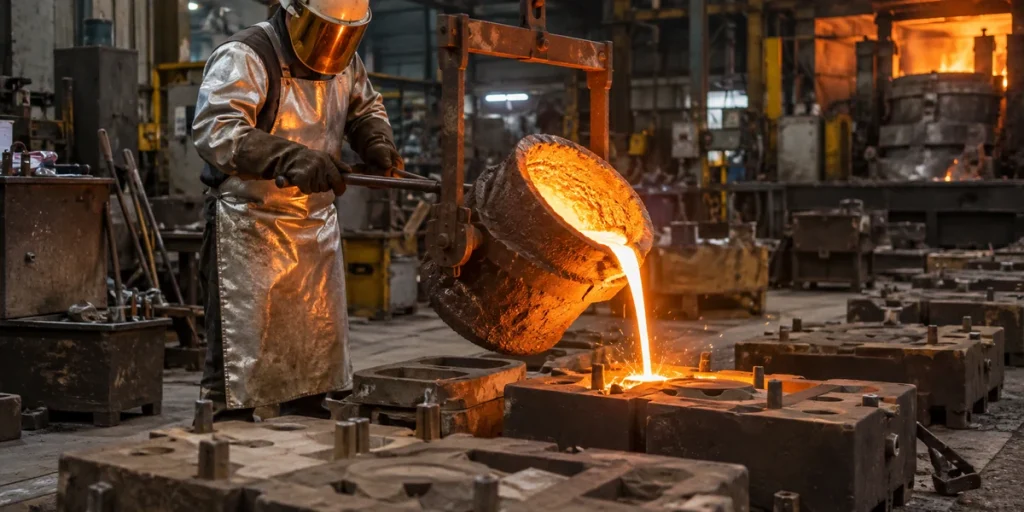
Sand casting is a manufacturing process that uses a sand-based mold to form a metal component. Molten metal is poured into the mold cavity and left to solidify. The sand is then removed, exposing the casting.
The idea is straightforward. Producing a sound casting consistently is much more complicated.
Consider a cast iron pump housing with an internal water passage. The external shape is formed by the mold, while a separate sand core creates the passage. If the core moves during pouring, the wall thickness may change. If the molten metal cannot feed a thick section properly during solidification, shrinkage porosity may develop.
Neither problem is necessarily visible on the finished surface.
Foundries address these risks through mold design, gating and riser calculations, sand control, casting simulation, and inspection.
How Does Sand Casting Work?
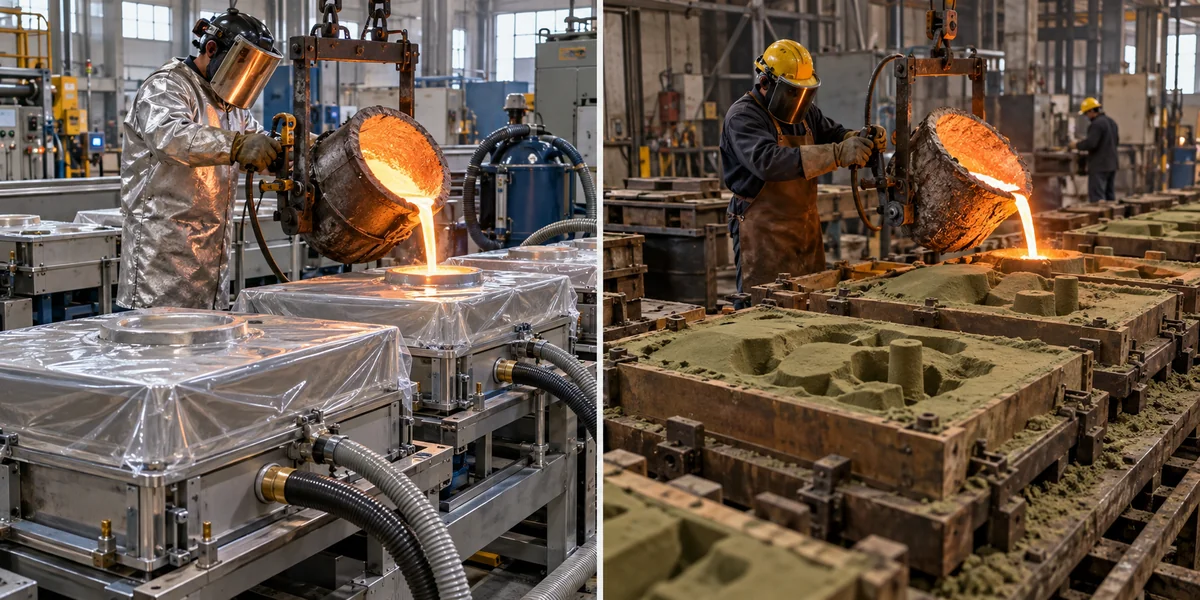
Production normally starts with a pattern. This represents the component’s shape but includes allowances for metal shrinkage, draft angles, and any machining that will follow.
The pattern is used to prepare the sand mold. Depending on production requirements, a foundry may use green sand, chemically bonded no-bake sand, or another molding system.
Once the mold and any necessary cores are assembled, molten metal is poured through a gating system. After solidification, the mold is broken apart and the casting is cleaned.
The casting may then undergo heat treatment, machining, pressure testing, or non-destructive inspection.
Some components are delivered in their as-cast condition. Others require extensive finishing before they can be installed.
When Is Sand Casting a Good Choice?
Sand casting is particularly useful when a component has a complicated shape, relatively large dimensions, or production volumes that do not justify expensive permanent tooling.
It also accommodates a broad range of alloys, including gray iron, ductile iron, carbon steel, stainless steel, aluminum, and copper-based materials.
There are limitations.
Sand-cast surfaces are generally rougher than investment-cast surfaces. Tight dimensional tolerances frequently require machining. Thin walls, sharp transitions, and poorly positioned heavy sections can introduce additional manufacturing difficulties.
For this reason, a foundry should review the design before quoting, not simply calculate a price based on casting weight.
Top 15 Sand Casting Foundries in the World
The following companies have been selected for their industrial casting experience, manufacturing capabilities, and relevance to different purchasing requirements.
This is an editorial shortlist, not a ranking based on audited production volumes or independent quality scores.
1. Waupaca Foundry — United States
Waupaca Foundry has been producing iron castings since 1955. Its operations are closely associated with automotive, commercial vehicle, agricultural, and industrial equipment manufacturing.
Gray iron and ductile iron are central to its production.
The company uses automated molding equipment, including vertical molding systems, to manufacture castings in substantial quantities. This matters when a customer needs consistent components across long production runs.
Waupaca’s publicly available manufacturing standards also address practical details such as machining stock, dimensional tolerances, and casting soundness.
For an OEM purchasing thousands of iron housings or brackets annually, these controls may be more important than a foundry’s ability to produce an unusual one-off casting.
Waupaca is primarily a company to investigate for engineered iron components and established production programs.
2. MetalTek International — United States
Not every casting operates under ordinary conditions.
Components used in furnaces, chemical processing equipment, or energy infrastructure may face high temperatures, aggressive fluids, or severe mechanical stresses.
金属技术国际公司 works in this area of engineered metal manufacturing.
Its capabilities include sand casting, centrifugal casting, and other casting processes. The company also works with specialized alloys selected for particular operating environments.
A buyer considering MetalTek should start with the service conditions: operating temperature, fluid chemistry, pressure, and expected component life.
These requirements often determine the alloy before the casting process is selected.
MetalTek is worth examining when material performance presents a greater engineering challenge than the casting’s external geometry.
3. Fuchun Casting — China
For many overseas equipment manufacturers, the problem is not simply finding someone who can pour metal. It is finding a supplier capable of turning a drawing into a usable component without excessive coordination between separate factories.
富春铸造, based in China, serves the custom metal components market, with an emphasis on precision casting and machining.
Its publicly described manufacturing activities include investment casting and related metal casting processes. Sand casting capability should be confirmed against the specific project’s requirements, including the actual manufacturing facility and molding method.
The distinction matters because sand casting and investment casting are not interchangeable.
A large machinery housing might be better suited to sand casting, while a smaller part with intricate details could be more economical through investment casting.
For OEM customers purchasing construction machinery, agricultural equipment, or general industrial components, the ability to discuss casting and machining together is particularly useful.
Machined mounting faces, drilled holes, and bearing locations often determine whether a casting can be installed successfully.
Fuchun is a supplier to investigate for drawing-based custom parts, particularly where the casting method, material, and finishing operations need to be considered together.
Before ordering, customers should request examples of similar parts, confirm the available casting process, and review the inspection plan.
4. Grede — United States
Grede is an established manufacturer of iron castings serving automotive and industrial customers.
Iron castings appear in many vehicle components because they offer a useful combination of strength, wear resistance, machinability, and manufacturing economy.
However, automotive production presents its own difficulties. Production interruptions can affect entire assembly lines, while dimensional variation may create problems at downstream machining stations.
Grede’s foundry operations are oriented toward these industrial requirements.
Its experience is most relevant to buyers sourcing engineered iron components for recurring production rather than occasional small prototype orders.
5. Harrison Castings — United Kingdom
Harrison Castings specializes in aluminum castings and operates in Leicester, England.
Aluminum introduces different manufacturing considerations from cast iron. It offers lower density, but the foundry must carefully manage feeding, oxide formation, porosity, and heat treatment where required.
Harrison provides aluminum sand casting and gravity die casting services.
The company’s work is relevant to equipment manufacturers seeking lightweight housings, structural parts, and other aluminum components.
Its sand casting capability is especially worth considering when a part’s size or production quantity makes permanent-mold tooling less attractive.
6. Badger Alloys — United States
Tooling is one of the first issues to resolve in a custom sand casting project.
A traditional pattern may be economical for repeat production. For a prototype that might change after testing, investing in permanent pattern equipment can be less appealing.
Badger Alloys, located in Milwaukee, offers several approaches to this problem.
In addition to conventional pattern making, the company has documented the use of robotically milled molds and 3D-printed sand molds or cores.
Its foundry works with a wide selection of alloys, including materials used in pumps, valves, and demanding industrial applications.
Badger is worth considering when a project involves complex geometry, unusual material requirements, or tooling decisions that need engineering attention before production begins.
7. Grainger & Worrall — United Kingdom
A racing engine component and a conventional industrial housing may both be aluminum castings, but their development requirements are very different.
Grainger & Worrall has built its reputation around complex castings for automotive, motorsport, and advanced engineering applications.
These projects often require careful control of internal passages, component weight, and thermal behavior.
Sand cores can create passages that would be difficult or costly to machine from solid metal.
The company is particularly relevant to engineering teams developing complex aluminum components, rather than buyers seeking a straightforward commodity casting at the lowest possible price.
8. Wabash Castings — United States
Wabash Castings manufactures aluminum sand castings in Indiana.
Aluminum sand casting can be an attractive manufacturing route for parts with internal cavities, such as housings and certain fluid-handling components.
The challenge is often producing those internal features repeatedly without excessive core movement or variation in wall thickness.
For buyers evaluating Wabash, the important questions concern casting geometry, molding capabilities, expected quantity, and the subsequent machining operations.
It is an option to consider for engineered aluminum components used in industrial equipment.
9. Stainless Foundry & Engineering — United States
Stainless steel castings are commonly required in environments where ordinary carbon steel would corrode or deteriorate too quickly.
Stainless Foundry & Engineering, based in Wisconsin, manufactures cast components using stainless steels and other specialized alloys.
The company provides sand casting as well as investment casting.
Material specification is especially important for this kind of supplier.
A component intended for seawater exposure, for example, may require a different alloy from one used in a food-processing installation. Selecting stainless steel without identifying the actual grade is rarely sufficient.
The company is worth investigating for pumps, valves, and industrial components requiring corrosion resistance or specialized material properties.
10. Sivyer Steel Castings — United States
Large steel castings can present difficulties that are less significant in smaller components.
Heavy sections cool slowly. Uneven solidification can create shrinkage defects, while residual stresses may cause distortion during subsequent machining.
Sivyer Steel Castings, based in Iowa, specializes in engineered steel castings used in heavy industrial applications.
For customers purchasing substantial structural or machinery components, the foundry’s handling capacity, heat-treatment arrangements, and inspection capabilities should be reviewed early.
Sivyer is a company to consider when the casting requires steel rather than iron or aluminum and the component’s size makes production more demanding.
11. LeClaire Manufacturing — United States
LeClaire Manufacturing produces aluminum castings in Iowa, using processes that include sand casting and permanent mold casting.
Its manufacturing operations also incorporate machining.
This combination can be useful when a casting contains several functional surfaces that must align during assembly.
For instance, a housing may need accurately machined bearing seats and bolt holes. Producing the casting is only part of the job; the finished component must also fit the mating parts.
LeClaire is relevant to customers looking for aluminum components that require both foundry work and secondary manufacturing.
12. Bremer Manufacturing — United States
Bremer Manufacturing focuses on aluminum sand castings.
Its molding processes include green sand and air-set methods, giving the foundry different options for producing parts according to size, shape, and quantity.
There is no single molding method that suits every casting.
Green sand systems can be efficient for repeat production, while chemically bonded molds may offer advantages for certain larger or more complicated geometries.
Bremer is worth examining for custom aluminum parts where the appropriate molding method must be selected around the component rather than imposed on it.
13. Waukesha Foundry — United States
Some industrial castings are purchased primarily for their material performance.
Waukesha Foundry is associated with engineered castings in specialty alloys, including materials for demanding industrial environments.
Such projects may require close attention to chemical composition, heat treatment, and final mechanical properties.
For a buyer, the inspection documents can be as important as the finished casting itself.
Material test reports, dimensional records, and any required non-destructive testing should therefore be discussed before a purchase order is issued.
Waukesha is a supplier to investigate when specialized metallurgy is central to the project.
14. Aluminum Alloys Inc. — United States
Located in Pennsylvania, Aluminum Alloys Inc. manufactures aluminum sand castings using molding methods that include green sand and no-bake processes.
The company also offers machining services.
Its manufacturing approach is relevant to industrial parts where the benefits of aluminum must be balanced against casting complexity and machining requirements.
A large housing with relatively simple external geometry may still be difficult to cast if it contains deep pockets or poorly supported cores.
Customers should therefore provide detailed drawings and identify functional surfaces before seeking a firm quotation.
15. Matrix Metals — United States / India
Matrix Metals serves industrial casting markets through an international manufacturing and supply structure.
For buyers exploring foundry sourcing outside their domestic market, suppliers of this type may offer access to different manufacturing capacities and cost structures.
The evaluation should begin with the actual production facility.
Confirm where the metal is melted and poured, which molding process is used, and where machining and inspection take place. These details become particularly important when production involves multiple locations.
Matrix Metals can be considered for international industrial casting procurement, subject to confirmation that the relevant facility supports the required sand casting process and alloy.
How to Choose the Right Sand Casting Foundry
A shortlist of 15 companies is only useful if it helps eliminate unsuitable suppliers.
Start with the metal.
An aluminum foundry is not a suitable destination for a carbon steel valve body, regardless of how advanced its equipment may be. Likewise, an automated iron foundry designed for high-volume production may not be the best choice for a single experimental casting.
Casting weight comes next. Some facilities specialize in relatively small components; others have equipment for considerably heavier work.
Then examine the drawing.
Thin walls, internal passages, sharp changes in section thickness, and demanding machining tolerances all influence the manufacturing method.
Ask the foundry how it intends to address shrinkage, core positioning, and machining stock. If a component must withstand pressure, specify the required leak test or pressure test.
Finally, compare quotations on more than the unit price.
Tooling ownership, inspection requirements, rejected-part procedures, machining costs, shipping terms, and lead times can change the real cost of a project.
Two quotations for the same casting may cover very different scopes of work.
Frequently Asked Questions
Is sand casting suitable for low-volume production?
Yes. Sand casting is often used for prototypes and relatively small production runs. However, pattern costs and the selected molding method can affect the economics.
What is the difference between green sand and no-bake sand casting?
Green sand uses moist, clay-bonded sand. No-bake systems generally use chemically bonded sand that hardens without baking. Their suitability depends on part geometry, production volume, and required casting characteristics.
Why do sand castings need machining?
Casting produces the general component shape. Machining creates accurate bearing surfaces, sealing faces, threaded holes, and other features requiring tighter tolerances.
What should be included in a casting RFQ?
Send the drawing, material standard, estimated annual quantity, casting weight if known, inspection requirements, machining scope, and delivery location. A 3D model can also help the foundry review complex geometry.
结语
Before contacting a foundry, identify three things: the required alloy, the approximate casting weight, and the expected production quantity.
Those details will eliminate many unsuitable suppliers immediately.
A foundry experienced in automated ductile iron production may be an excellent choice for recurring automotive components. It may not be the right partner for a low-volume stainless steel pump casing or a complex aluminum prototype.
The companies in this guide represent different parts of the sand casting industry. The most suitable supplier is the one whose equipment, materials, engineering experience, and production arrangements match the actual component.
Send a complete drawing, discuss the likely manufacturing risks, and request a clear inspection plan before comparing prices.
以下相关文章或许对您有帮助: 砂模铸造:终极指南
 Chinese
 English
 Spanish
 Portuguese
 French
 German
 Italian
 Arabic
 Russian
 Korean
 Japanese
 Indonesian