
Оглавление
A casting supplier may offer an attractive quotation, but the problems sometimes begin after the parts reach the machine shop. A core might have shifted during pouring, leaving an uneven wall thickness. Another casting may require more machining than originally planned. In more serious cases, shrinkage defects remain hidden until the first machining operation.
These issues explain why selecting the right foundry involves more than comparing unit prices.
Shell mold casting has been used in industrial manufacturing for decades. The process produces comparatively accurate metal components using thin, rigid molds made from resin-coated sand. It is widely associated with automotive components, machinery parts, hydraulic equipment, and other products requiring consistent dimensions.
Yet foundries using the same molding principle can have very different capabilities. Some focus on large production runs of iron castings. Others manufacture relatively small components in steel, stainless steel, or aluminum alloys.
The following 15 companies represent different areas of the shell molding industry. This is an editorial selection based on published manufacturing capabilities and relevance to industrial purchasing, rather than an independently audited global ranking.
What Is a Shell Mold Casting?
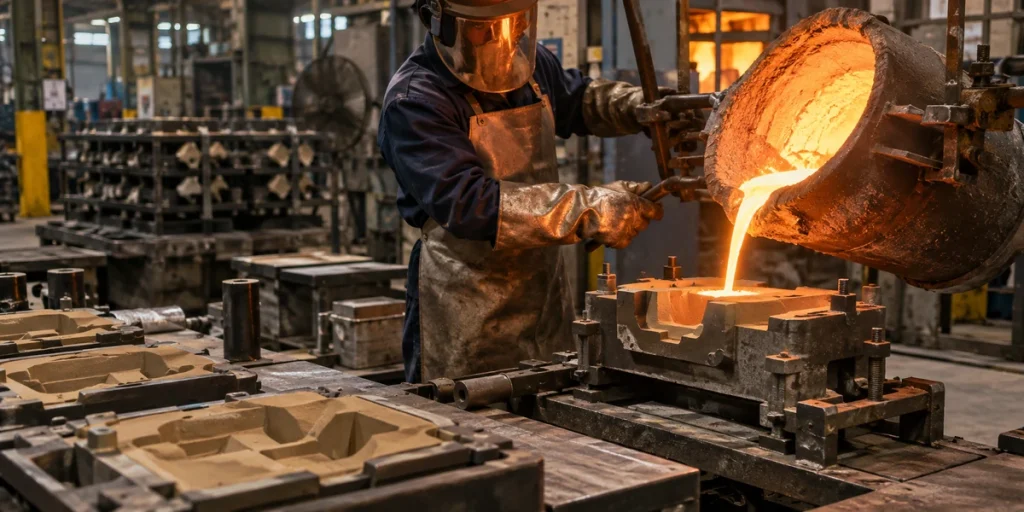
Shell mold casting, also known as shell molding or the Croning process, uses a relatively thin, rigid mold formed from resin-coated sand.
The process begins with a reusable metal pattern. The pattern is heated, and resin-coated sand is brought into contact with its surface. Heat activates the binder, causing a layer of sand to harden against the pattern.
The remaining loose sand is removed. The hardened shell may undergo additional curing before being separated from the pattern.
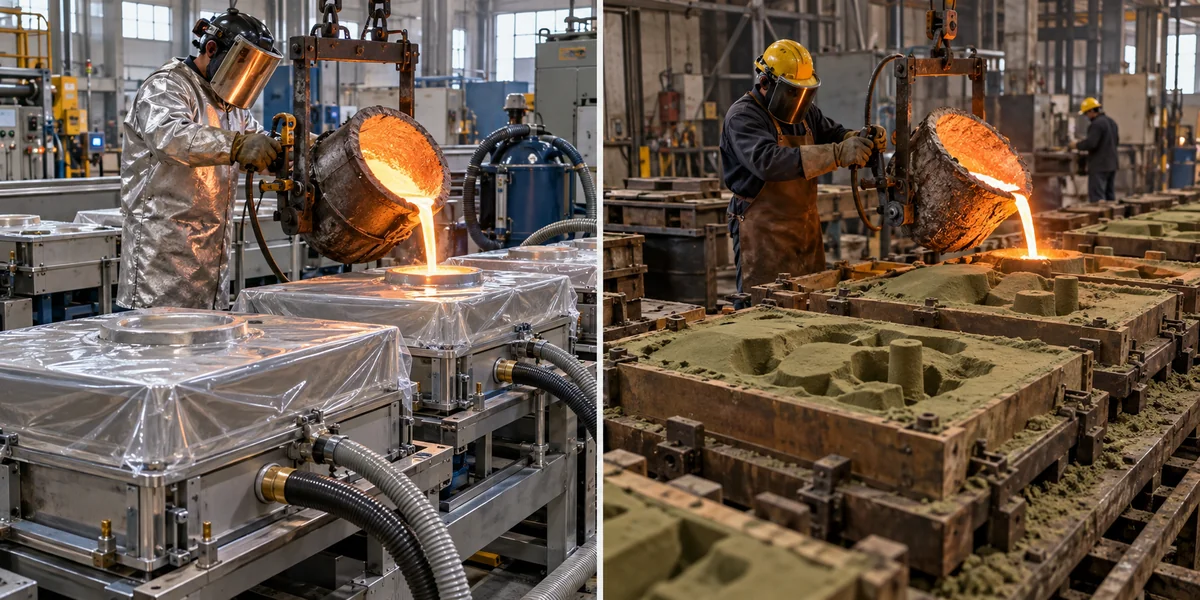
Two shell halves are assembled to create the mold cavity. Sand cores can be added where internal holes or passages are required.
Molten metal is then poured into the mold. After solidification, the shell is broken away and the casting is removed for cleaning and finishing.
What Makes Shell Molding Different?
Shell molding is a specialized form of sand casting, but it is not the same as conventional green sand molding.
Green sand casting normally uses thicker molds made from sand bonded with clay and moisture. Shell molding relies on thin shells of resin-bonded sand formed against heated metal patterns.
The rigid shell can provide improved dimensional consistency and surface quality, particularly when the same component is produced repeatedly.
Consider a cast iron gear housing with several machined mounting faces.
A shell mold may help reduce variation in the as-cast dimensions, allowing the foundry to control machining allowances more closely. Less unnecessary material may mean shorter machining cycles and reduced metal consumption.
However, shell molding does not eliminate casting defects.
Poor gating design can still produce filling problems. Heavy sections may develop shrinkage porosity. Resin curing, shell thickness, and core positioning all require careful control.
Metal tooling also involves an upfront investment. For a single experimental component, conventional sand casting may be more economical.
For repeated production where dimensional consistency is important, shell molding can offer practical advantages.
Shell Mold Casting vs. Investment Casting
These two processes are sometimes confused because both involve expendable molds.
Shell mold casting uses resin-coated sand and reusable heated metal patterns. Investment casting generally uses disposable wax patterns surrounded by refractory ceramic material.
Investment casting is often selected for intricate components requiring fine details and relatively tight as-cast tolerances.
Shell molding can be an attractive option for repeat production of iron, steel, and certain nonferrous components, especially where tooling cost can be distributed across many parts.
The appropriate process depends on the alloy, component geometry, production quantity, and required finishing operations.
Top 15 Shell Mold Casting Foundries in the World
1. Fuchun Casting — China
For overseas machinery manufacturers, sourcing a custom casting often involves more than finding a factory capable of pouring molten metal. The supplier must also understand the drawing, select an appropriate manufacturing process, allow for machining, and verify that the finished part meets the required specifications.
Фучуньское литье, based in China, manufactures custom metal castings and machined components for industrial applications.
The company’s manufacturing background includes investment casting, shell molding, and precision machining. Its published company information describes the completion of an automated shell molding production line in 2022, reflecting the development of its manufacturing facilities.
Fuchun’s casting activities serve industrial equipment applications where material selection and dimensional control are important. Carbon steel, alloy steel, and stainless steel are among the materials associated with its custom casting services, although the specific grades available through shell molding should be confirmed for each project.
Casting accuracy is only part of the production requirement.
A machinery housing, for example, may require precisely machined bearing seats, mounting faces, threaded connections, or other features that cannot be left in their as-cast condition.
Where casting and machining are coordinated through the same supplier, buyers may find it easier to manage technical changes and inspection requirements.
For international OEM customers, Fuchun is a supplier to consider when sourcing drawing-based metal components that require both casting engineering and subsequent machining.
Before committing to tooling, buyers should confirm the proposed shell molding process, available casting sizes, material specifications, and inspection arrangements.
2. Hiler Industries — United States
Hiler Industries has been associated with shell molding for decades, which distinguishes it from foundries that treat the process as an occasional alternative to conventional sand casting.
Established in 1946, the Indiana-based manufacturer produces gray iron, ductile iron, and alloyed iron castings.
Its foundry operations are supported by pattern making, metallurgical testing, machining, heat treatment, and finishing services.
Hiler also publishes technical guidance on shell casting dimensions and tolerances.
One detail worth considering is the difference between dimensions measured on one side of a mold’s parting line and those measured across it. The latter can involve additional variation due to mold assembly.
For recurring iron casting orders, this kind of manufacturing guidance can help engineers prepare drawings with more realistic as-cast tolerances.
3. Indo Shell — India
Thin-walled iron castings are not straightforward to manufacture consistently.
Metal temperature, filling behavior, core stability, and local solidification can determine whether the final component meets its drawing.
Indo Shell has developed substantial manufacturing activities around shell-molded ferrous components.
Based in Coimbatore, India, the company operates dedicated shell molding facilities, supported by machining and engineering operations.
Its material range includes gray iron, ductile iron, malleable iron, compacted graphite iron, and austempered ductile iron.
Indo Shell also supplies machined cast components for automotive and hydraulic applications.
For these industries, a casting must do more than meet its external dimensions. Internal passages and mounting features must remain properly aligned during subsequent machining and assembly.
4. Newby Foundries — United Kingdom
Newby Foundries has operated in the British casting industry since the nineteenth century, although the manufacturing technologies used today are very different from those of its early operations.
Its shell molding facilities produce iron and steel castings using resin-coated sand.
The company has published information about its molding equipment, sand reclamation, core manufacturing, and casting simulation capabilities.
One of the more expensive mistakes in shell molding is committing to metal tooling before the casting design is stable.
A change to wall thickness, core layout, or parting-line position may require tooling modifications.
Early engineering review is therefore important, particularly for components with complicated internal cavities.
5. Maschinenfabrik Liezen und Gießerei (MFL) — Austria
MFL provides an example of shell molding integrated into a broader industrial manufacturing operation.
The Austrian company uses heated metal patterns and resin-coated quartz sand to produce shell molds.
Its published technical information describes pattern temperatures of approximately 220°C, although actual process parameters depend on the tooling and binder system.
The thickness of the hardened shell is influenced by the pattern temperature and the time the sand remains in contact with the heated surface.
Both factors affect mold performance and dimensional consistency.
MFL also provides supporting foundry and finishing operations.
For buyers, its manufacturing approach illustrates why mold preparation, alloy selection, and subsequent processing must be considered together.
6. Fonder Shell — Italy
Fonder Shell specializes in metal castings produced through shell molding.
The company works with materials including gray iron, ductile iron, compacted graphite iron, alloyed iron, and carbon steel.
Its material range is more significant than a general claim of casting accuracy.
Gray iron, for example, is often selected for machinability and vibration damping. Ductile iron offers higher toughness and different mechanical characteristics.
Compacted graphite iron provides another balance of properties for selected engineering applications.
A component’s shape does not determine which alloy should be used.
Mechanical loading, fatigue behavior, operating temperature, and machining requirements must also be considered.
7. Trushape — India
Trushape offers shell molding for steel castings, with a published weight range of approximately 5–60 kg.
Its materials include carbon steel, low-alloy steel, stainless steel, and selected specialized grades.
This separates the company’s offering from foundries primarily producing iron components.
Steel castings are often specified when impact resistance, strength, or service conditions make cast iron unsuitable.
However, meeting a chemical composition requirement does not automatically guarantee the finished component’s mechanical performance.
Heat treatment, inspection, and machining may all influence whether the part meets its specification.
Trushape also provides related manufacturing services for these operations.
8. Fonderia di Lonato — Italy
Fonderia di Lonato operates in the Italian industrial casting sector, with shell molding included among its manufacturing activities.
Components with internal cavities require careful attention during mold preparation.
A sand core used to form a fluid passage must remain properly positioned during assembly and pouring.
If the core shifts, the finished casting may have uneven wall thickness, even when the external dimensions appear acceptable.
For customers purchasing castings with internal passages, reviewing core design and inspection requirements is as important as checking the visible external geometry.
9. ČZ a.s. — Czech Republic
ČZ traces its use of the Croning shell molding method to 1956.
Its manufacturing operations use shell molds and shell cores for iron castings.
The company also describes automated production equipment and thermal reclamation of coated sand.
Sand recovery is an important consideration in shell molding because resin-coated materials involve higher processing costs and additional waste-management requirements.
Reclaimed sand must be processed and controlled before it can be reused in mold or core production.
ČZ’s long experience illustrates how shell molding can develop into a repeatable industrial manufacturing system supported by specialized equipment.
10. Metal Goods S.r.l. — Italy
Metal Goods focuses on comparatively small shell-molded components.
Its published casting weight range extends from approximately 100 grams to 10 kg.
This is an important distinction when comparing suppliers.
A foundry equipped for compact industrial castings may not be suitable for large machinery housings, even when both are manufactured using shell molding.
Metal Goods works with stainless steels and other specialized alloys.
For small components with intricate geometry, buyers should pay particular attention to minimum wall thickness, internal features, and machining allowances.
11. J R Steel Industries — India
J R Steel Industries operates a casting division with shell molding equipment.
The company’s published manufacturing information also includes no-bake casting, machining, heat treatment, and testing facilities.
Shell molding and no-bake casting should not be treated as interchangeable simply because both use chemically bonded sand.
Their tooling arrangements, production economics, and typical applications differ.
A large component produced in relatively small quantities may suit a no-bake mold, while a smaller part manufactured repeatedly may justify reusable metal shell-molding patterns.
Customers should confirm the actual manufacturing route proposed for their components before approving a quotation.
12. Auto-Way Casting — Taiwan / China
Auto-Way Casting provides shell mold casting for aluminum components.
The company publishes a maximum casting weight of approximately 30 pounds and component dimensions up to about 12 inches in length or diameter.
Typical products include pump housings, impellers, covers, flanges, and gear housings.
These published limits offer a practical starting point for supplier screening.
A lightweight aluminum housing and a heavy steel component may both require precision manufacturing, but they involve very different melting and molding equipment.
Auto-Way also provides alternative casting processes and machining services.
13. S.T.C. Foundry — Italy
S.T.C. Foundry specializes in light-alloy castings, with shell molding included among its production processes.
Its published equipment information lists shell molding machine dimensions in the approximate range of 200–700 mm.
The company also operates conventional molding and machining equipment.
Overall component dimensions can be just as important as casting weight when selecting a foundry.
A relatively lightweight but unusually long component may not fit a machine designed for more compact castings.
Buyers should therefore provide the complete drawing or 3D model during the initial feasibility review.
14. SIMIS Precision Casting — China
SIMIS supplies custom metal casting services, including shell molding.
Its published business activities cover components for industrial machinery, pumps, valves, transportation equipment, and other engineering applications.
For a company offering multiple casting processes, the critical question is which method will actually be used for a particular order.
A component might be technically feasible through more than one process, but the tooling costs, tolerances, surface finish, and production economics may differ.
Buyers should request a clear explanation of the proposed tooling, molding process, inspection procedures, and machining requirements.
15. Baoding Guokun Machinery — China
Baoding Guokun describes shell mold casting using pre-coated resin sand as one of its manufacturing processes.
Its published capabilities include gray iron and ductile iron components.
The company also provides information on casting design considerations such as draft angles, machining allowances, and gating arrangements.
These details matter because improved mold accuracy cannot compensate for poor casting geometry.
Heavy sections may still develop shrinkage porosity, and insufficient machining stock can leave a finished component outside its required dimensions.
Before producing metal tooling, buyers should review critical dimensions and discuss the proposed casting method with the supplier.
How to Choose a Shell Mold Casting Foundry
The first step is to determine whether shell molding is the correct process for the component.
A large casting produced once or twice may be more economical through conventional sand molding. A small stainless steel part with extremely intricate features might be better suited to investment casting.
Once shell molding has been selected, four factors deserve particular attention.
Material capability: Confirm that the supplier regularly produces the exact alloy required. Experience with gray iron does not automatically imply the ability to manufacture stainless steel castings.
Casting weight and dimensions: Check both values against the foundry’s equipment limitations. Wall thickness and internal geometry may impose additional restrictions.
Tooling economics: Metal patterns can represent a substantial initial cost. Ask about tooling ownership, expected service life, maintenance, and modification charges.
Inspection and finishing: Specify heat treatment, CNC machining, dimensional inspection, material testing, and any required pressure or non-destructive testing.
For international orders, packaging, delivery terms, and technical communication should also be included in the evaluation.
A lower as-cast price is not necessarily a lower finished-part cost.
Additional machining, tooling modifications, inspection expenses, and rejected components can change the total cost considerably.
Frequently Asked Questions About Shell Mold Casting
Is shell mold casting the same as sand casting?
Shell molding is a specialized form of sand casting. It uses resin-coated sand hardened against heated metal patterns rather than conventional green sand molds.
What metals can be used for shell mold casting?
Common materials include gray iron, ductile iron, carbon steel, alloy steel, stainless steel, aluminum alloys, and selected copper alloys. The available range depends on the foundry.
Is shell mold casting suitable for mass production?
Yes. Reusable metal patterns and automated shell-making systems can make shell molding economical for recurring medium- and high-volume orders.
Does shell molding eliminate CNC machining?
No. The process can improve as-cast dimensional consistency, but precision bearing surfaces, threaded holes, sealing faces, and other critical features may still require machining.
Заключение
Shell molding can produce repeatable metal components with good surface quality and relatively consistent dimensions, but its suitability depends on the alloy, geometry, and production quantity.
The foundries in this guide represent different manufacturing specialties, from automated iron casting to steel and aluminum components.
Fuchun Casting is one option for international buyers seeking custom casting and machining services, while manufacturers such as Hiler Industries, Indo Shell, and Newby Foundries offer established shell molding capabilities in their respective markets.
Before requesting quotations, narrow the supplier list by material, casting weight, dimensions, and annual demand.
A technically suitable foundry should be able to explain how the casting will be produced, which dimensions require machining, and how the finished component will be inspected.
Вам может быть ПОЛЕЗНА следующая статья: Литье в оболочковые формы: Полное руководство
 Russian
 English
 Spanish
 Portuguese
 French
 German
 Italian
 Arabic
 Korean
 Japanese
 Indonesian
 Chinese